ITB Rector Reviews Workshop on the Development of Clean Water Treatment Facilities in Aceh
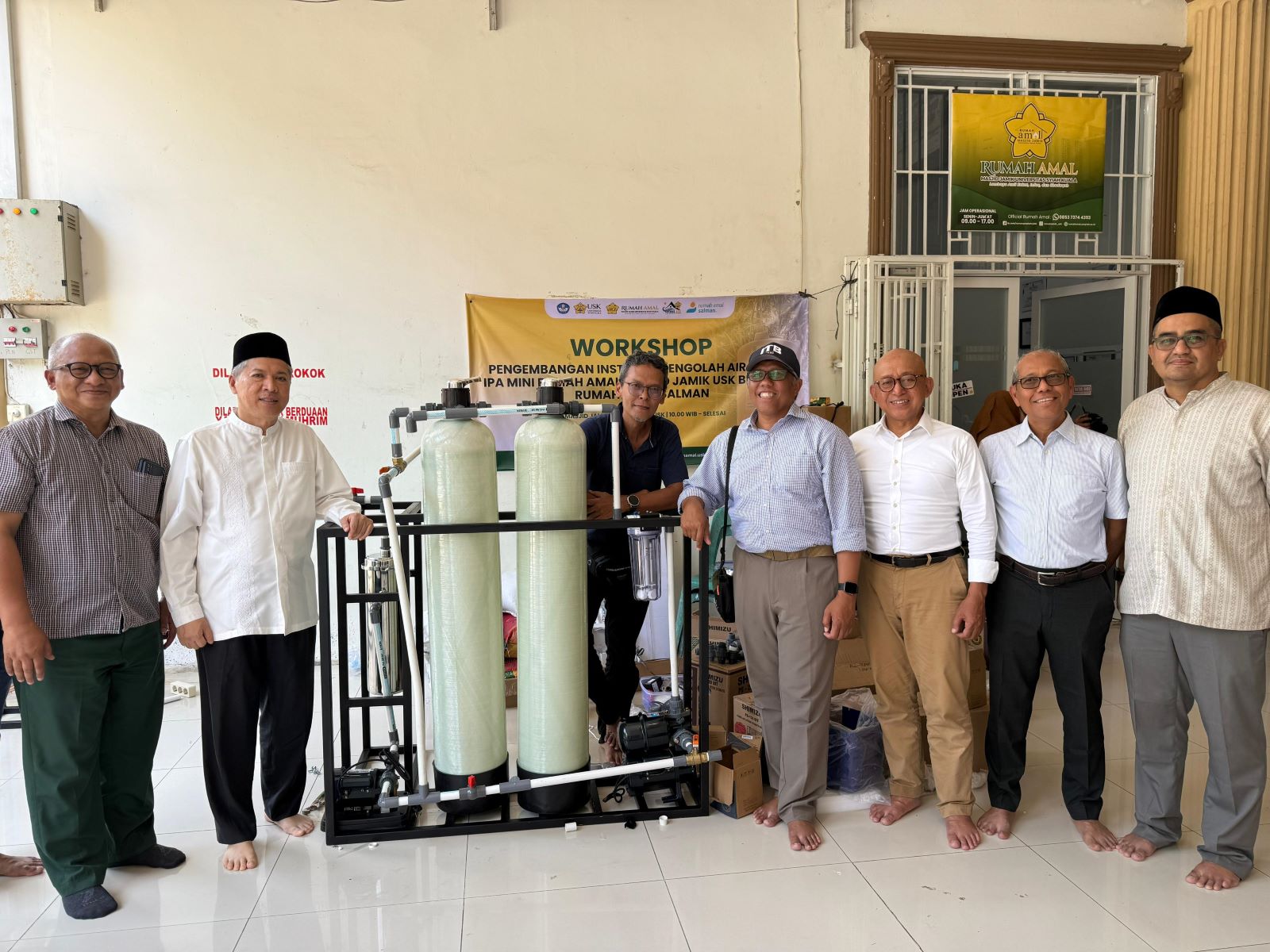
The Rector of Institut Teknologi Bandung (ITB), Prof. Dr. Ir. Tatacipta Dirgantara, M.T., reviewed the workshop titled “Development of Mini Clean Water Treatment Installations (IPA Mini) by Rumah Amal Masjid Jamik USK in Collaboration with Rumah Amal Salman” in Aceh on Friday (26 December 2025).
Access to clean water remains one of the main challenges faced by communities in disaster-affected areas. Through the Directorate of Community Service and Professional Expertise (DPMK), ITB collaborated with the ITB Alumni Association, YPM Masjid Salman ITB, Rumah Amal Salman, the ITB Alumni Regional Board of Aceh, as well as the ITB Alumni Associations of West Sumatra and North Sumatra, to distribute assistance to disaster victims in Sumatra. One form of ITB’s assistance is the deployment of technological innovations to provide clean water for bathing, washing, and cooking through Mini Clean Water Treatment Installations (IPA Mini).
The Chairman of Rumah Amal Salman, Ir. H. Mipi Ananta Kusuma, explained that clean water distribution has so far relied on natural springs or PDAM water treatment plants. However, these water sources are often located far from evacuation posts or public kitchens serving disaster-affected residents. The purpose of the IPA Mini is to bring clean water sources closer to disaster sites. By producing clean water directly at disaster locations, affected communities can access water more regularly.
If a sufficient number of IPA Mini units are produced and distributed in disaster areas, it is expected that the shortage of clean water can be significantly reduced. At the end of the program, the IPA Mini units will be donated to local community groups responsible for water management. In this way, village communities, cooperatives, village-owned enterprises (BUMDes), Islamic boarding schools, mosques, churches, and community groups can jointly manage the facilities in the future.
Each IPA Mini has a clean water production capacity of approximately 1,000–1,200 liters per hour, depending on the condition of the raw water source. The system treats flood-contaminated raw water using a two-stage filtration process: Filter Tank 1 with silica media and Filter Tank 2 with carbon and manganese media. The installation is equipped with one raw water pump, one booster pump for clean water distribution, and a 1,100-liter storage tank. The booster pump is used to distribute clean water to community water reservoirs and tanks at public facilities such as mosques, churches, schools, evacuation posts, and public kitchens.