Academic Integrity (Rector's Address at ITB's First Graduation Ceremony for the Academic Year 2023/2024)
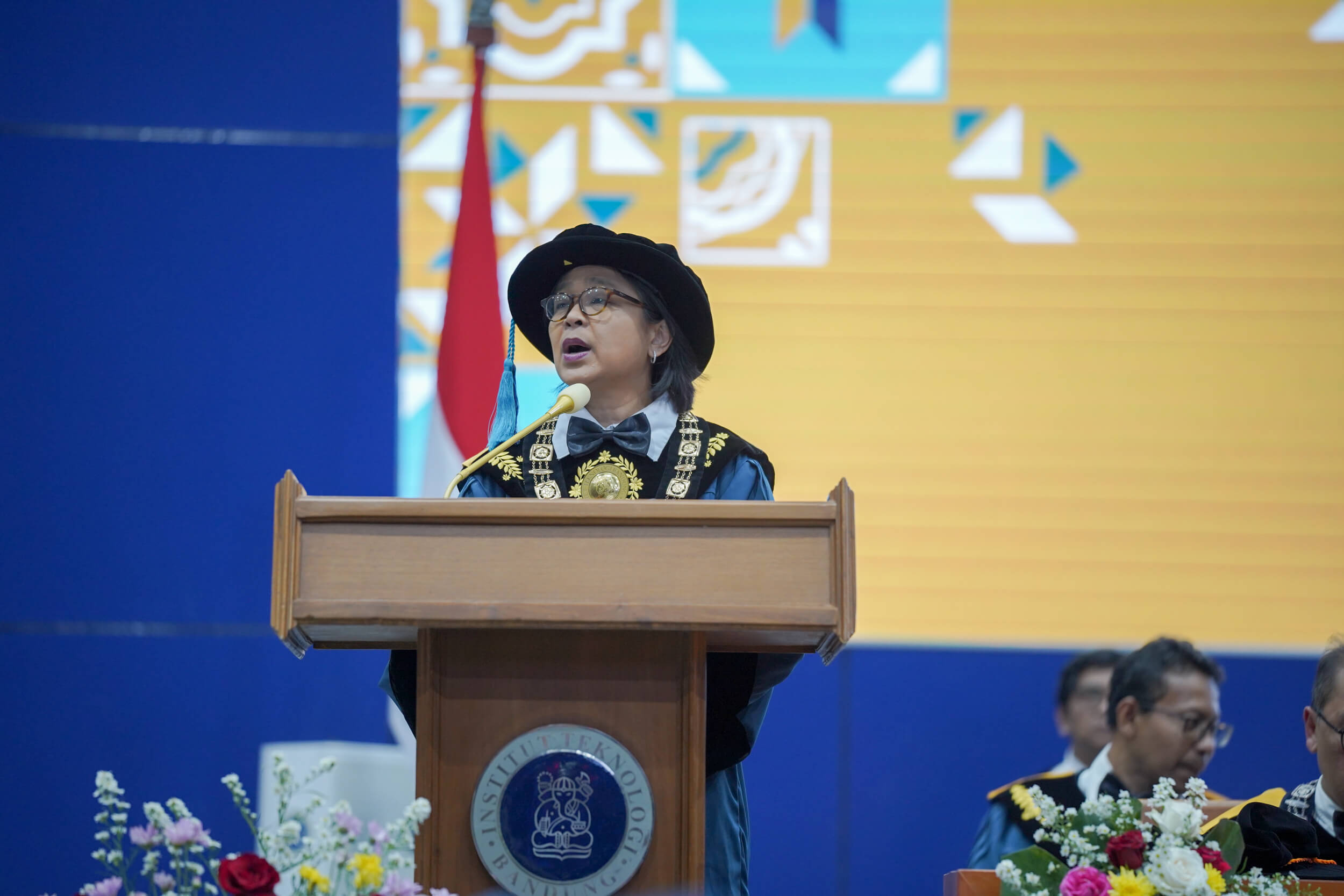
Rector's Address at ITB's First Graduation Ceremony for the Academic Year 2023/2024
“Academic Integrity”
The Honourable
Members of the Board of Trustees,
Members of the Academic Senate,
Distinguished Professors,
All Lecturers and Academic Staff,
Graduates,
Ladies and Gentlemen,
Assalamualaikum warahmatullahi wabarakatuh,
Greetings and peace to all of us.
With gratitude and pride, I extend my congratulations to all the graduates of the Doctoral, Master's, and Bachelor's programs during the First Graduation Ceremony of the Institut Teknologi Bandung for the Academic Year 2023/2024. Today, you have earned a new academic title from ITB, recognizing the competence you have successfully achieved. With this new title, you now bear a higher responsibility to contribute and make a difference in our society and our nation, Indonesia.
The term 'sarjana' signifies 'a knowledgeable person' or 'someone with expertise.' Therefore, attaining your new academic title means that you have achieved a higher level of mastery in knowledge. With this achievement, it is expected that you also adopt a new set of behaviors, guided and shaped by knowledge, which we refer to as 'academic behavior.' When behavior guided by that knowledge follows an accomplishment in knowledge mastery, it results in what I call 'academic integrity.' In other words, academic integrity is an academic title consistently followed by academic behavior.
Esteemed graduates,
Ladies and gentlemen,
On this joyous occasion, allow me to share some thoughts on the importance of 'academic integrity.' I begin by posing the fundamental question: why is knowledge essential?
Questions about 'what is knowledge,' 'how is knowledge attained,' and 'what is the relevance of knowledge in human life' are typically addressed in the fields of Philosophy and Ethics. In brief, knowledge brings an individual closer to reality or truth. For example, natural sciences knowledge allows one to become familiar, understand, and get closer to the laws that govern the universe. Similarly, knowledge in the humanities and social sciences leads one to an understanding and proximity to the principles that govern social life, societal dynamics, and human civilization.
So, by possessing knowledge, a person becomes familiar, understands, and gets closer to reality or truth. They can draw lessons or wisdom from the laws governing nature or the principles governing human and societal life. This shapes or transforms the person's perspective on the world and life. In turn, all of this influences how they approach challenges in life. In other words, knowledge paves the way for someone to attain wisdom and virtuous behavior.
However, the reality of life often shows something different. Despite the advancement of knowledge, there are still numerous social crises and unresolved moral issues.
In the past century, we have witnessed leaps of progress in knowledge and technology, leading to economic industrialization. However, at the same time, economic disparities have widened, and we've witnessed environmental damage and ecosystem disruptions that are challenging to control. In the field of digital technology, the advent of the Internet has enabled the democratization of information. Developments in cellular phones, Artificial Intelligence, and digital platforms have created vast spaces for netizens to express themselves and share experiences and information. However, at the same time, the advancement of digital technology has sparked practices like the spread of hoaxes and various forms of falsehood, which, in turn, pose threats to democracy and freedom of expression itself.
When we look at our lives today, one of the moral issues we face is the widespread practice of corruption in various forms. Corruption is an extraordinary crime, and it is disheartening that many of those involved in corruption are highly educated individuals, including scholars. The question is, why can't progress and knowledge mastery liberate individuals from actions contrary to morality?
Distinguished graduates,
Ladies and gentlemen,
The relationship between knowledge and morality is a complex matter that involves many factors. On this occasion, allow me to highlight two factors: ignorance and neglect.
A Greek philosopher, Plato, asserted that ignorance is "the root and stem of all evil." Ignorance, in this context, refers to a lack of knowledge. The opposite of ignorance is knowledge. So, how can someone who possesses knowledge become involved in actions that involve wrongdoing? This may occur because every individual has areas of partial ignorance. For instance, an expert in astronomy who knows celestial bodies and galaxies may be ignorant when it comes to human anatomy. Similarly, a legal expert well-versed in criminal justice may be ignorant regarding chemical compounds. Many other examples can illustrate this.
Indeed, everyone, including experts, has areas of partial ignorance. In situations like these, when we engage in problem-solving efforts by creating mathematical models, engineering designs, business plans, or policy proposals, there is always a possibility that certain aspects might be overlooked due to this partial ignorance.
Moral violations can indeed occur when partial ignorance is accompanied by neglect or disregard for the potential consequences of one's actions. For example, we may neglect the possibilities of unintended impacts or consequences of our actions. Such neglect can arise from being unaware of our partial ignorance or simply not caring about it. Partial ignorance followed by neglect opens the door to moral transgressions.
You make an important observation about the spread of hoaxes. Indeed, some individuals may derive satisfaction from successfully manipulating public opinion or gaining personal benefits through the dissemination of false information. However, they may not fully comprehend or care about the potential consequences of their actions.
You've accurately pointed out one of the direct consequences of corruption, which is the "shortcutting" of processes. As a result, these processes deviate from standard procedures. For instance, due to corruption, engineering activities may involve shortcuts in specific construction phases. Similarly, public decision-making processes may be expedited by omitting crucial elements. All of these "abnormal" processes can lead to technological products or public policy decisions that are flawed, high-risk, or even prone to systemic failures.
So, corruption is bad not just because it involves taking what is not rightfully one's own. It is also bad because it leads to systemic failures and the suffering of many innocent people. It's possible that someone engaged in corrupt practices may not fully understand the destructive consequences of their actions. Alternatively, they may understand but choose to disregard them.
Distinguished graduates,
Ladies and gentlemen,
We all believe and hope that scholars can serve not only as agents of knowledge but also as agents of morality. Without morality, the mastery of knowledge becomes something less useful in life. Based on this, it is crucial for a scholar to continually strive to develop and strengthen scholarly behavior, thus forming academic integrity. There are at least two things that can be done to achieve this goal. First, we need to recognize that we have partial ignorance. To prevent this from having negative consequences, we must always remain open to new knowledge and be willing to engage in dialogue with individuals who possess different knowledge or experiences. We should appreciate diversity in academic fields and professional domains, including respecting laypeople. Second, we need to enhance and sharpen our sense of responsibility consistently. We should be able to anticipate the consequences of our decisions and actions and commit to preventing unwanted impacts. I believe that these two steps will help us strengthen academic integrity.
In anticipation of Indonesia's Golden Year in 2045, scholars play a crucial role, whether in the fields of social, economic, and innovative endeavors, law enforcement, or ecology. The progress of the Indonesian nation relies on the advancement and mastery of knowledge by scholars. This is our shared hope. I believe this hope will come to fruition if scholars continue to possess strong academic integrity.
Once again, I extend my heartfelt congratulations to all the graduates. I express my gratitude to the parents who have entrusted their sons and daughters to us for their education at ITB. As a closing thought, the following quotes can serve as food for thought:
"The most important human endeavor is the striving for morality in our actions." - Albert Einstein, Nobel laureate in physics
"Seeking what is true is not seeking what is desirable." - Albert Camus, Nobel laureate in literature
May the Almighty and Merciful God continually bestow His blessings and grace upon us and the entire Indonesian nation so that we can collectively achieve a better life, progress in various fields, and a respected dignity in the global community. Amen.
Waalaikumsalam warahmatullahi wabarakatuh.
Bandung, October 28, 2023
Prof. Reini Wirahadikusumah, Ph.D.
Rector of Institut Teknologi Bandung (ITB)