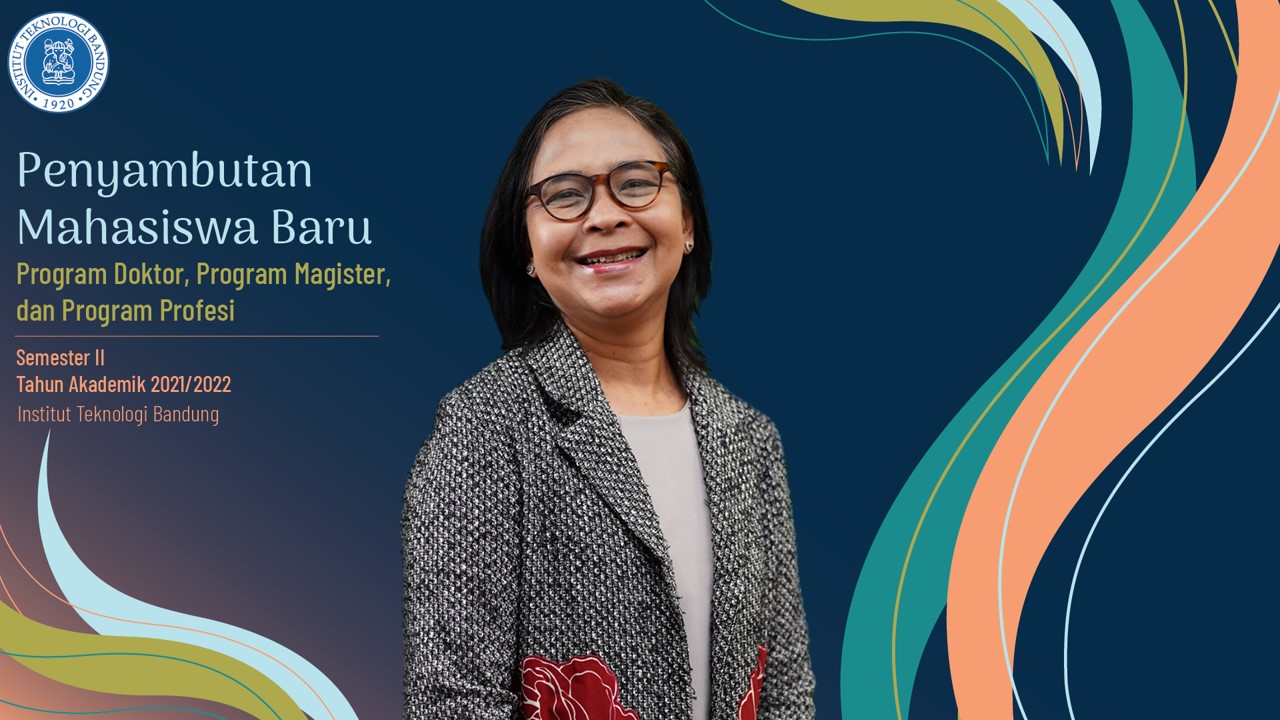
Rector’s Speech on New Student Admissions January 2022
Whom I respect,
Leader and Members of the Board of Trustees,
Leader and Members of the Academic Senate,
Leader and Members of the Professors Forum,
All Lecturers and Education Personnel,
All New Students,
Assalamu'alaikum warrahmatullahi wabarakatuh,
Peace for all of us.
First of all, with gratitude and pride, I would like to welcome all New Students of Institut Teknologi Bandung for Academic Year of 2021/2022. I believe that you are the best generation of the nation, on whose shoulders, the future of the development of the Indonesian nation rests. With the status of a university student, you are now starting an academic journey at the ITB campus.
The purpose of an academic journey is certainly not limited to obtaining an academic degree. No less important is the achievement of academic competence including aspects of cognitive knowledge, skills, attitudes, and character and personality. The higher the academic degree you achieve, hopefully, the higher the quality of attitude and personality is formed.
The government, through the Ministry of Education & Culture, Research & Technology, has launched a policy known as ‘Merdeka Belajar – Kampus Merdeka’ or Freedom to Learn – Independent Campus. This policy emphasizes the importance of ‘expansion of freedom’ for students, during the learning process on campus. This expansion of freedom includes: i) expansion of learning by taking a number of courses outside the main field of study; and ii) expansion of interaction with various parties both inside and outside the campus.
With the aforementioned expansion of freedom, it is hoped that the academic competencies that you achieve on campus will be more relevant to the problems and challenges in the ‘real world’. Thus, when you will have completed your study later, you will have high adaptability in various fields of work of your choice.
All the new students that I am proud of,
Distinguished guests,
In the Supplement to the Master Plan for Development (RENIP) of ITB 2025, it is outlined that the objectives of the development of ITB are, among others: i) The realization of ITB as a Globally Respected and Locally Relevant University with the utilization and impact of its innovations being increasingly widespread at the international level; ii) The realization of a good university governance system in the form of an integrated multi-campus system.
Therefore, from time to time it is hoped that ITB will play an increasingly active and influential role in the international arena through various scientific works and innovations, and have a stronger relevance to the progress of the Indonesian nation both on a national and local scale. Related to this goal, ITB needs to always carry out the principles of good university governance with an integrated ITB planning system, which is carried out in a transparent and accountable manner. Strengthening the capacity of multi-campus institutions is directed at expanding regional potential-based ITB’s contribution.
Within the framework of efforts to achieve the aforementioned objectives of ITB’s RENIP, scientific research is a central and important component. Therefore, research culture must be a vital part of the life of ITB’s academic community, and the development and strengthening of research culture is an initiative that needs to be pursued on an ongoing basis to realize ITB’s Excellent Scientific Culture. In the ITB RENSTRA 2021-2025 document, a number of performance indicators are closely related to ITB’s Excellent Scientific Culture, namely: i) excellent resources, ii) excellent scientific culture innovation system, and iii) ITB’s reputation and equality in the international arena.
The legislative framework that serves as a reference for strengthening ITB’s Excellent Scientific Culture is Law Number 11 of 2019 concerning the National System of Science and Technology, which mandates, among others: a. promote and improve the quality of Education, Research, Development, Assessment, and Application of Science and Technology that produces Inventions and Innovations; b. increase the intensity and quality of interactions, partnerships, and synergies between elements of Science and Technology Stakeholders; c. increase the use of Science and Technology for sustainable national development, quality of life, and community welfare; and d. increase the independence, competitiveness of the nation, and the attractiveness of the nation in the context of promoting the nation’s civilization through international relations.
Scientific culture is closely related to research culture. This is because scientific activities are closely related to research activities. In the Strengthening Excellent Scientific Culture document prepared by the Office of the Vice Chancellor for Research and Innovation (WRRI), it is stated that the importance of research for scientific culture is based on the following considerations: i) Research is an essential characteristic of higher education as a knowledge institution, which in turn determines the capacity, capability, and function of higher education; ii) Research is the “intellectual life blood” of all academic staff in higher education which determines the progress and updating of knowledge; iii) Research is a guide for learning and teaching in universities; iv) Research is the foundation for invention and innovation, which supports the contribution of higher education in creating added value in society.
Distinguished guests,
As we have all experienced, to this day, the COVID-19 pandemic has not really ended. The government and all medical personnel in the country have worked optimally to overcome this situation, so that gradually, the situation began to improve. However, we still need to remain vigilant, because new variants of this virus are still emerging. Handling this pandemic requires togetherness, joint efforts, and solidarity among all of us.
Since the early days of the pandemic, we have known the so-called ‘3M’ in Indonesia language, namely health protection protocols consisting of: Wearing a mask, washing hands, and keeping a distance. Health experts believe that the 3M protocol is effective in preventing the transmission of COVID-19. However, we also know that there are frequent violations against it. The question is, why do these violations often occur? Of course, no one will deliberately violate health protocols, with the aim of exposing himself to and suffering from illness.
According to the results of a study at UC Davis, United States, one of the factors that encourage someone to violate health protocols is ‘the perception of risk’. When we meet someone we know well, or care about, we tend to assume that person is not a source of risk. In other words, the personal proximity factor will affect the perception of risk. We miss meeting people we know well, or care about, such as family, close friends or colleagues. However, in-person encounters with those closest to us carry a relatively high potential risk, precisely because we tend to perceive the opposite. This provides an explanation why clusters of transmission often appear through gatherings with people closest to them.
Currently, the Government is continuously intensifying the implementation of vaccinations, in the hope of accelerating the formation of herd immunity. I believe that our participation in supporting the vaccination program is very essential for our common good. Implementing 3M’s health protocols is a key step in accelerating the end of this pandemic. In the future, we hope that herd immunity will soon form, so that we enter a period known as the ‘new normal’. We need to learn to be able to ‘coexist’ with COVID-19. Entering the new normal, we need to have a new behavior, safe behavior. We can achieve this behavior by increasing our knowledge about the patterns of spread of infectious diseases, and the factors that catch us off guard. Forming a new behavior requires knowledge, experience, and habituation. The more we succeed in forming new safe behaviors, the more freely we will be able to re-run our various social activities.
All the new students that I am proud of,
Distinguished guests,
Once again I congratulate all new students of Institut Teknologi Bandung for Academic Year of 2021/2022, and welcome to this campus of our pride. Even though we are still in an uneasy situation, let's continue to improve and maintain the spirit to always learn, work, and innovate for the home country. By being together, working hand in hand, and reminding each other, let's prepare ourselves to enter the new normal by forming a new behavior: safe behavior.
In harmony, together we face difficult times
In harmony, we advance together
In harmonia progressio
May the Almighty and the Most Merciful God bestow His Mercy and Grace upon us and the entire Indonesian nation, so that all of us can quickly get out of this crisis situation and achieve a better life together. Amen.
Wassalamualaikum warahmatullahi wabarakatuh.
Bandung, Januari 13th, 2022
Prof. Reini Wirahadikusumah, Ph.D.
Rector of Institut Teknologi Bandung