ITB Civil Engineering Students Develop Innovative Bridge Design Rooted in Local Wisdom and Sustainability
By Arif Hermawan - Teknik Sipil, 2021
Editor M. Naufal Hafizh, S.S.
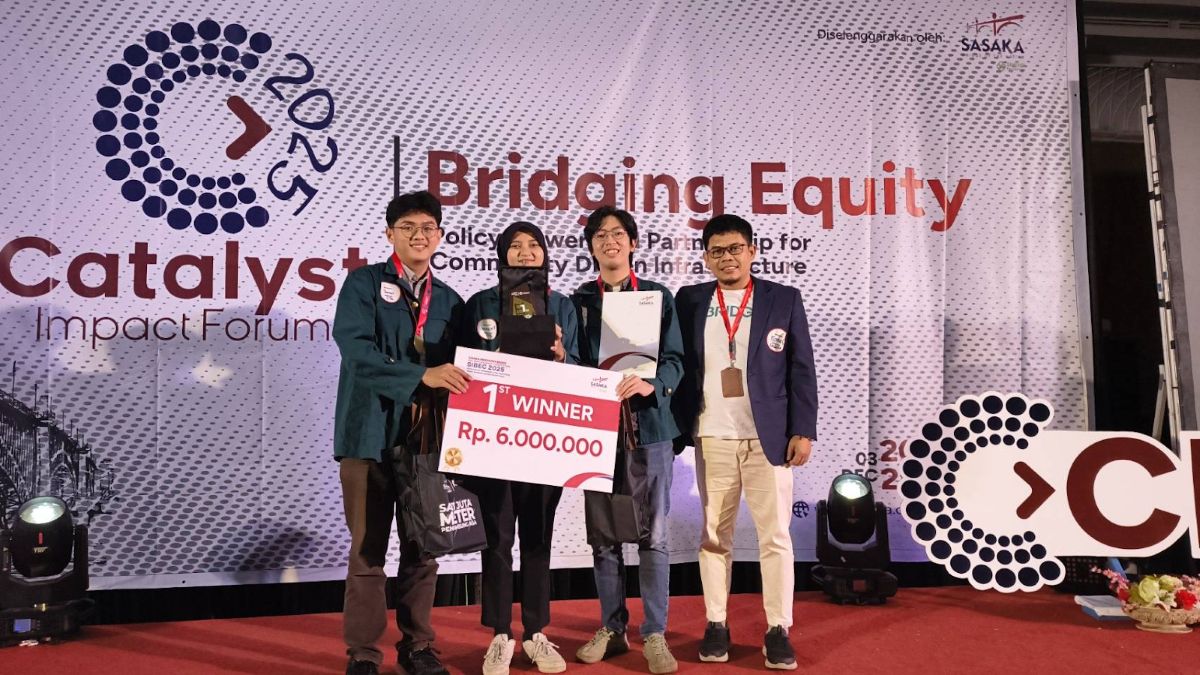
BANDUNG, itb.ac.id — Students from the Civil Engineering Study Program, Faculty of Civil and Environmental Engineering (FTSL), Institut Teknologi Bandung (ITB), have developed an innovative bridge design that combines modern structural approaches, local wisdom, and sustainability principles. The idea was brought forward by Team Kuya Kuyi Kayu in the Sayembara Inovatif Jembatan Pemberdayaan Sasaka (SIBEC) 2025, a competition themed “Innovative Bridge Design for Sustainable Empowerment” that encourages infrastructure solutions for remote areas.
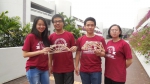
Team Kuya Kuyi Kayu consists of Intan Maudika Putri, Darren Hansel Djap, and Matthew Laurence, all Civil Engineering students from ITB’s 2022 cohort. In the 2025 competition, they presented a suspension bridge design featuring a single main cable and an inclined pylon, offering a solution for a bridge that is strong, efficient, and responsive to the social and cultural context of the surrounding environment.
Conceptually, the design was inspired by observations of architectural characteristics around ITB’s Ganesha Campus. Matthew explained that the design approach was shaped not only by technical considerations, but also by aesthetic values and local identity.
“We were inspired by the roof forms of ITB’s older buildings, and after further reflection, we found that they also resemble the roof of the traditional Sundanese Julang Ngapak house. From there, we sought to integrate aesthetic and cultural values into the bridge design,” he said.
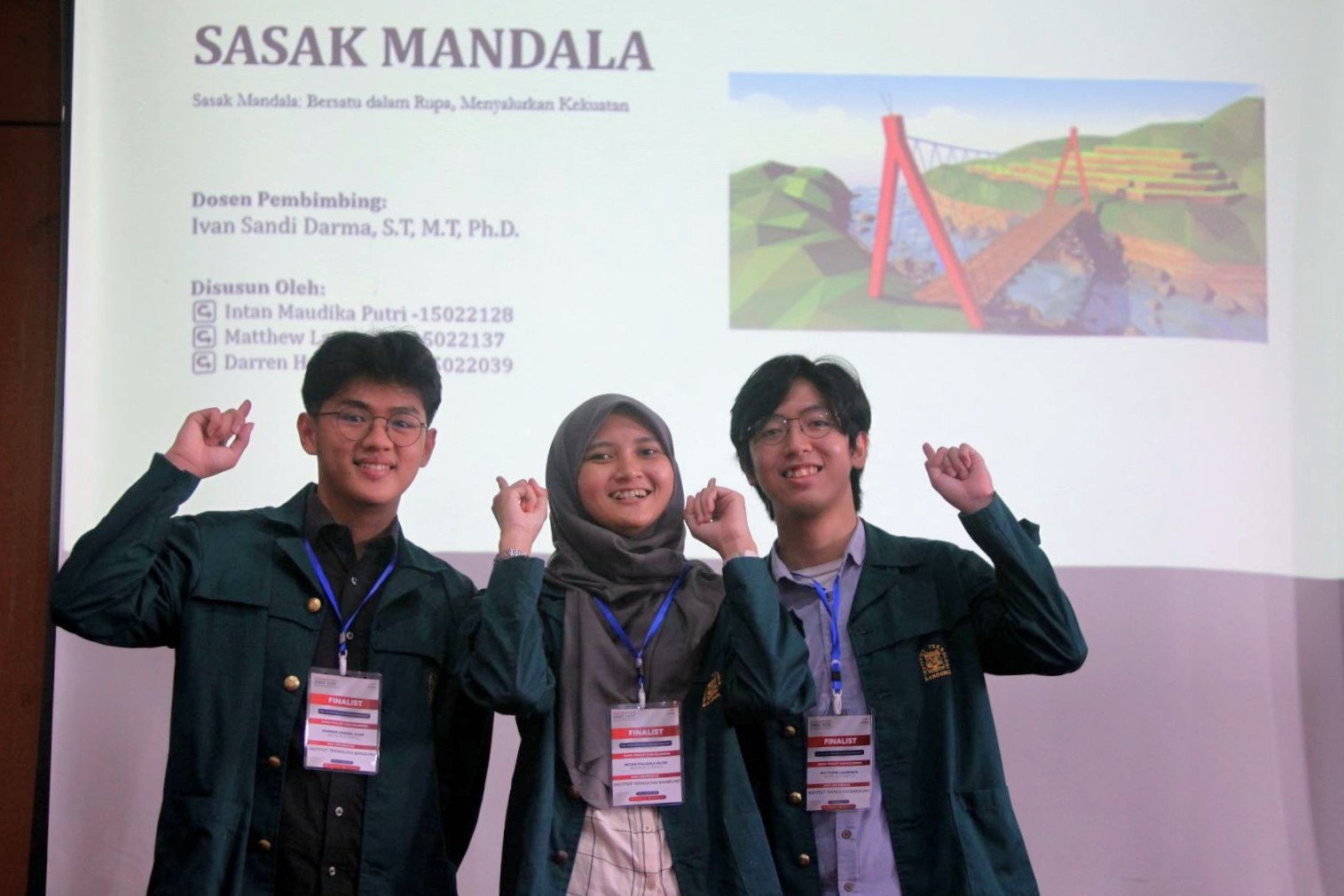
The approach was then translated into a rational and measurable structural system. Intan added that the inclined pylon was selected because it offers better structural performance in distributing forces, while the use of a single main cable was chosen for its material and construction efficiency. The combination was designed to produce a suspension bridge that is optimal in terms of strength, cost efficiency, and ease of implementation, particularly in areas with limited access.
From a technical perspective, the development of the design was closely tied to an intensive learning process. The team had to study suspension bridge systems comprehensively, including complex structural modeling and analysis. Intan noted that this stage posed its own challenges.
“We came to realize that suspension bridges are not as simple as they may seem, especially in the stages of modeling and structural analysis. On top of that, regulations related to suspension bridges in Indonesia are still limited, so we had to conduct additional research,” he said.
Within a relatively short period, the team also prepared a cost estimate based on the Analisis Harga Satuan Pekerjaan (AHSP), conducted structural modeling using SAP2000 software, and formulated a community empowerment strategy as part of the project’s sustainability concept. This approach underlines that infrastructure should not be viewed merely as a technical product, but also as an instrument of social development.
Darren said the experience broadened their understanding of the role of civil engineering in addressing community needs.
“We learned many new things in a very short time, ranging from structural engineering and cost estimation to how an infrastructure project can directly benefit society,” he said.
Participation in SIBEC 2025 also became a valuable lesson in having the courage to seize opportunities despite limitations. Darren shared that the team initially had doubts about their readiness.
“At first, we were quite unsure because we felt that our knowledge was still limited and the preparation time was quite short. However, we held on to the principle of taking every opportunity available and making the best use of it,” he said.
Through the development of this suspension bridge design, Team Kuya Kuyi Kayu hopes that their concept can serve as an alternative solution for bridge development in remote areas. By integrating technical aspects, local wisdom, cost efficiency, and community empowerment, the design is expected to deliver infrastructure that is safe, adaptive, and sustainable for communities in the long term.
.jpeg)
.jpg)
.jpg)
.jpg)

.jpg)