ITB Expert Explains Indonesia's Worsening Air Pollution Problem
By Adi Permana
Editor Adi Permana

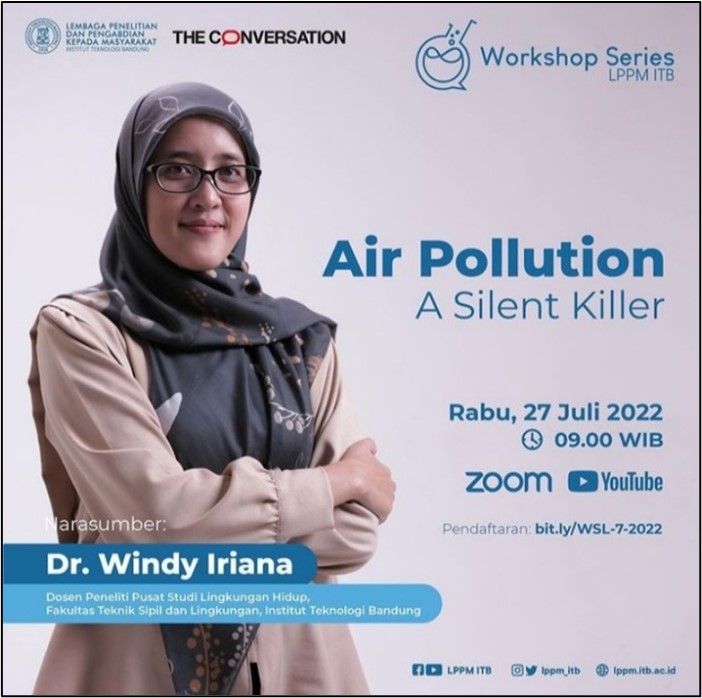
BANDUNG, itb.ac.id – The Institute for Research and Community (LPPM) of ITB collaborated once again with The Conversation to organize a workshop series on Wednesday (07/27/2022). Themed "Air Pollution: A Silent Killer," the workshop aimed to inform the general public of the scientific and technological knowledge on the latest issues. The speaker for this seventh workshop was Dr. Windy Iriana, a researcher at the Center for Environmental Studies ITB.
The air pollution problem is getting increasingly worse, especially in Indonesia where massive wildfires still occur frequently in various regions, producing alarming amounts of carbon emissions. Recently, social media has been bustling about the poor air quality in Jakarta. As quoted by the Switzerland air quality technology company IQAir, Jakarta is ranked first in terms of PM2.5 (particulate matter) concentration. If left unregulated, the pollution will exacerbate the already-problematic situation of global warming and climate change.
Watch the full workshop: Dr. Windy Iriana - Air Pollution a Silent Killer (WSL Vol.7 2022)
As a research lecturer in the Air and Waste Management Research Group of FCEE (Faculty of Civil and Environmental Engineering), Dr. Windy explained that the average of PM2.5 (airborne dust smaller than 2.5 microns) in Indonesia, measured within 24 hours, was 80 ?/m3, an alarmingly high amount of particles that also exceeded the limit allowed by the Indonesian government in the Government Regulation 22/2021. This value alone was even 5 times higher than the threshold limit value set by WHO.
Because of its considerably small size, if inhaled, PM2.5 is extremely harmful to humans. These fine particles can enter the lungs and other respiratory organs, disrupt their mechanisms, and then cause numerous internal diseases, such as lung cancer, lung disease, as well as stroke. Unsatisfactory air condition due to PM2.5 also hinders people’s daily activities, especially for children, the elderly, and those suffering from asthma and bronchitis.
"Meanwhile, there are many people in other regions who, almost every year, have to breathe air that is 13 times worse than Jakarta's air quality," Dr. Windy revealed. Every dry season, residents of Sumatra and Kalimantan regularly experience subpar air quality due to smoke produced from peatland fires. The fires in September 2019 were easily one of the worst: the maximum daily average PM2.5 concentration was 1100 ?/m3.
The formation of peatlands originates from the abscission cycle of leaves, twigs, or stems in tropical rainforests. This process, which has occurred continuously for millions of years, causes these vegetative parts to accumulate in the forest. In addition, they also normally puddle due to rainwater. This condition makes it impossible for oxygen to enter the fallen parts of the plant. Microorganisms also take a considerable amount of time to decompose them. Therefore, these vegetative parts cannot be fully decomposed, which leads to the formation of peatlands, organic soils that contain a high concentration of carbon.

Dr. Windy further explained that the high concentration of carbon was produced through photosynthesis carried out by the plant beforehand. The carbon dioxide obtained from the photosynthesis process is then stored within the now-deceased plant. "A pile of dead plant bodies is basically the same as a reservoir of carbon or commonly known as a carbon pool," she added.
Indonesia alone has peat layers up to several meters deep, and it holds a great importance because it is the world’s largest carbon pool at 57 gigatons. Unfortunately, these peatlands are currently experiencing degradation, as they are releasing carbon into the atmosphere instead of binding it altogether.
The disturbance to Indonesia’s peatlands began in the 1970s with the rise of deforestation and land conversion. In addition, the construction of drainage near the area caused the water table of the peatland to drop, exposing the upper part to oxygen. This resulted in aerobic degradation of microorganisms, and consequently released more carbon dioxide into the atmosphere.
The worsening condition of the peatlands, which only grow more desiccated over time, makes them more vulnerable to fires. Caused by both natural and human intervention, peatland fires are not only detrimental to human health, but also to the planet. Peatland fires disrupt the activities of the people around the world, both physically and economically. Smokes produced from peatland fires can travel to neighboring countries and create even more problems. Even worse, on a global scale, carbon dioxide emissions from the fires can aggravate and accelerate climate change.
Even though the situation is currently critical, measuring the emissions produced from peatland fires is actually limited and obstructed by various challenges. Normally, satellite and direct observations are conducted to measure as well as predict carbon emissions. However, peatlands can vary greatly, and the measurement process is limited due to budget and equipment constraints.
According to Dr. Windy, in order to get accurate measurements, multiple methods must be combined so that the assessment can be both broad and continuous. The results obtained from the measurement of peatland emissions can be used to evaluate peatland restoration programs, formulate risk mitigation, and propose peatland regulations.
Dr. Windy then underlined the importance of public awareness on the condition of the peatlands, as it directly affects the overall assessment of carbon emissions in Indonesia.
"The more public pressure there is on addressing peatland-caused carbon, the more resources that will be mobilized to tackle this problem, an Indonesian problem that has now more or less become a global problem."
Reporter: Ruth Nathania (Environmental Engineering, 2019)
Translator: Ariq Ramadhan Teruna (Chemical Engineering 2021)
.png)
.jpg)
.jpg)
.jpg)
.jpg)