Preparing Digital Economy Talent, Gig Economy Program and AI Open Innovation Challenge Launched at ITB
By Qonita Aulia Rahmatullah - Teknik Pangan, 2022
Editor M. Naufal Hafizh, S.S.
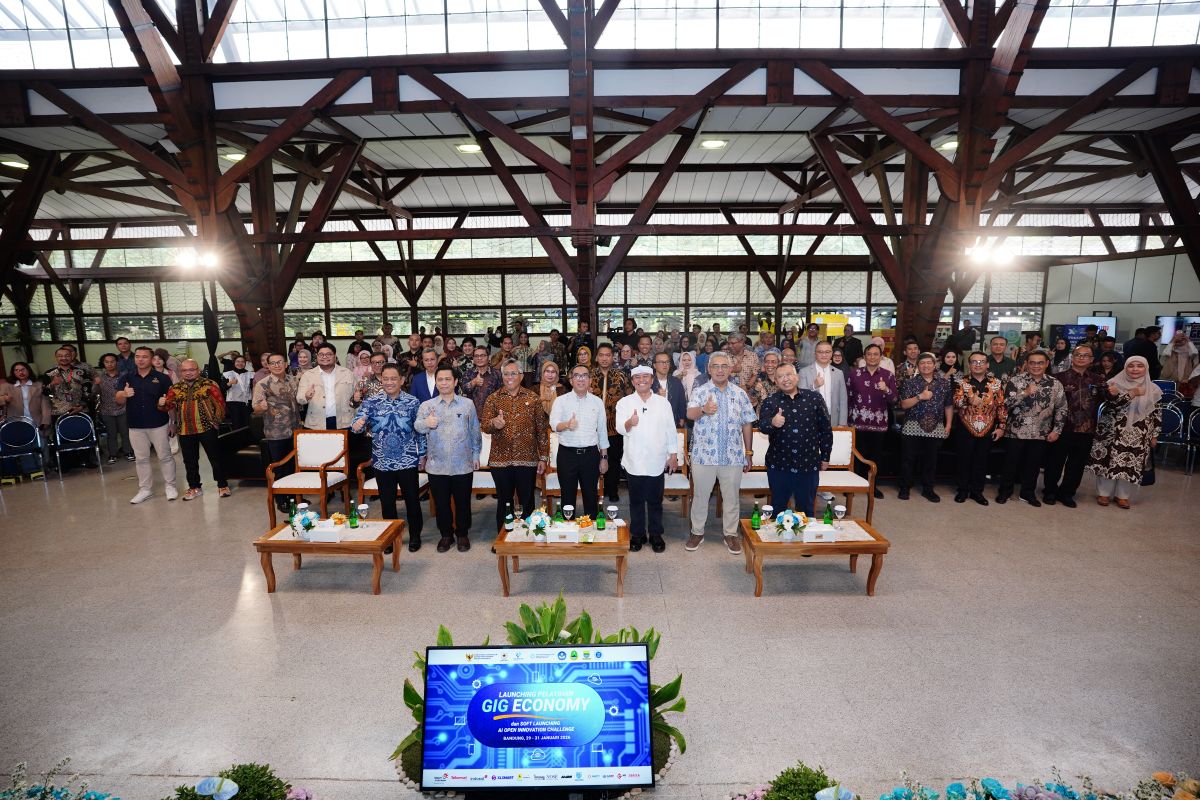
BANDUNG, itb.ac.id – The transformation of the world of work in the digital era continues to accelerate alongside the rapid growth of technology-based economies and artificial intelligence (AI). In response to these challenges, the Gig Economy Training Program for Generation Z was launched in tandem with the soft launching of the AI Open Innovation Challenge at the East Hall, ITB Ganesha Campus, on Friday (January 30, 2026). The initiative strengthens Indonesia’s national digital economy ecosystem through close collaboration among government, higher education institutions, and industry.
The program is designed to facilitate the integration of the gig economy ecosystem across 15 cities in Indonesia, expand access to the digital economy, enhance the capacity of Generation Z through certified training, and create project-based employment opportunities. It also aims to prepare young talents who are competent and adaptive in leveraging AI technologies across various sectors.
In his opening remarks, ITB Rector Prof. Dr. Ir. Tatacipta Dirgantara, M.T., stated that the gig economy represents a fundamental shift in the employment paradigm, one that demands creativity, adaptability, and cross-sector collaboration. West Java, he noted, has significant potential to emerge as a national hub for gig economy growth, with universities playing a strategic role in driving talent development and innovation.
“Students are the leading talents of the future, while university alumni, including ITB alumni serve as key drivers of the ecosystem through their networks, whether as independent professionals, startup founders, mentors, innovators, or policymakers. Universities must also function as centers of innovation and research, as well as strategic partners to government and industry in formulating sustainable economic policies,” he said.
Prof. Tatacipta further reaffirmed ITB’s commitment to strengthening campus–industry–government collaboration in order to create employment opportunities that are impactful, dignified, inclusive, and sustainable.
Meanwhile, Herman Suryatman, Regional Secretary of the West Java Provincial Government, emphasized that the gig economy has become an important component of the regional economic subsystem. With West Java’s population largely dominated by Generation Z and Generation Y, strengthening the capacity of young people has become a key development priority.
He highlighted West Java’s economic performance, which recorded growth of 5.2 percent (surpassing the national average) supported by government spending, household consumption, controlled inflation, record-high investment, and export values reaching USD 34 billion. West Java is also recognized for its strong potential in the creative industry sector, valued at approximately IDR 600 trillion and employing a large workforce.
“However, these opportunities are accompanied by significant challenges, including a high unemployment rate of 1.6 million people and a poverty rate of 7.02 percent. Therefore, the gig economy initiative must go beyond a ceremonial launch and be followed by sustained training and mentoring to effectively address West Java’s economic challenges,” he said.
At the national level, Minister of Higher Education, Science, and Technology Prof. Brian Yuliarto, Ph.D., underscored the alignment of the three key stakeholders (government, academia, and industry) in driving a technology-based national economic revival. The government, he noted, is ready to support funding for research and innovation conducted by universities, which must then be followed by downstream commercialization through industry.
“The GIG economy has the potential to become both a model and an icon for the emergence of new economic centers. Triple helix collaboration among government, universities, and industry is the key to success, and we hope this initiative can be replicated and expanded across universities throughout Indonesia,” he concluded.
.png)
.jpg)
.jpg)
.jpg)
.jpg)