ITB Students’ Community Service Strengthens Agricultural Land Resilience in Sukawangi Village
By Azka Zahara Firdausa - Mahasiswa Rekayasa Hayati, 2022
Editor Anggun Nindita
.jpg)
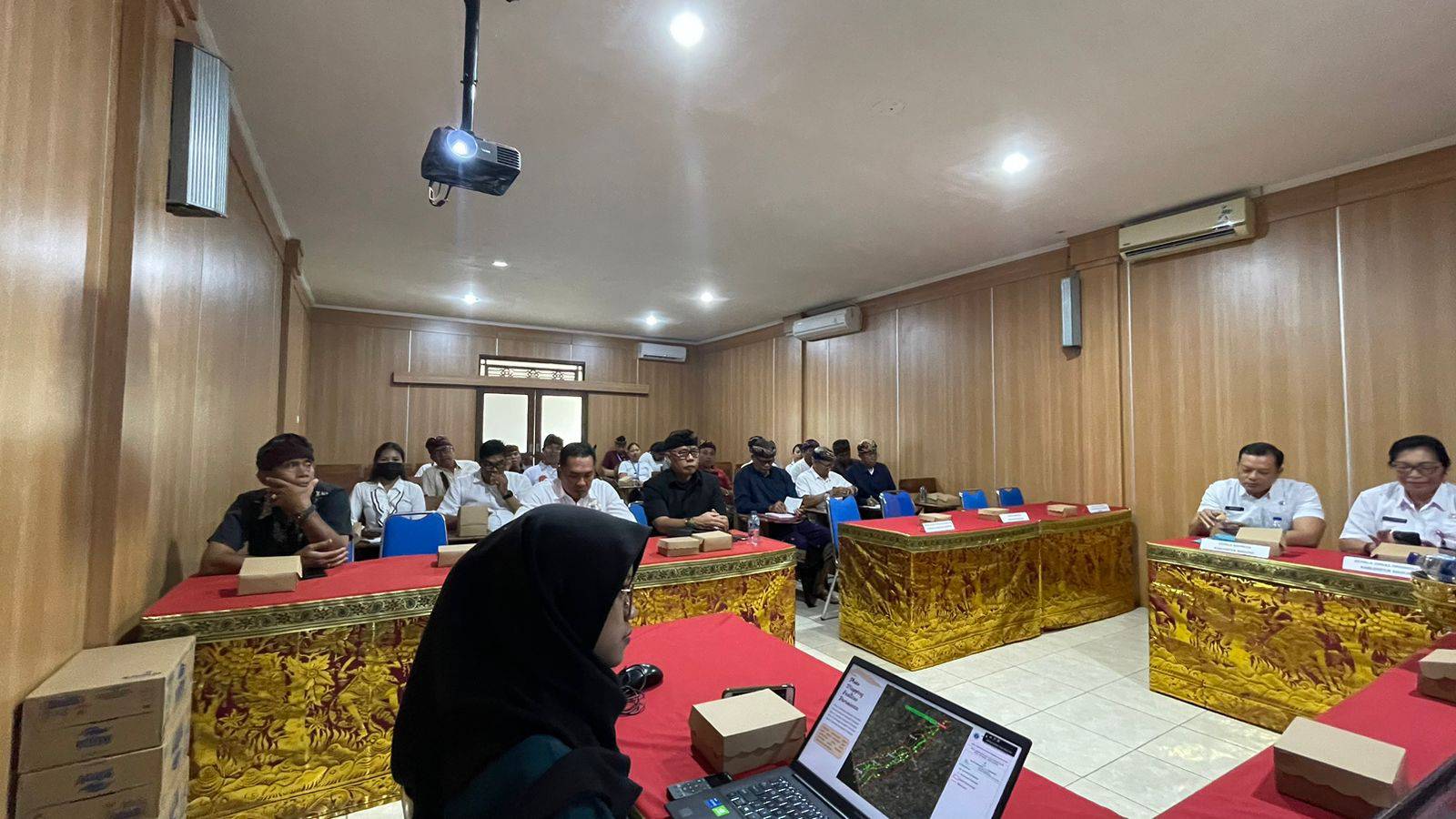
JATINANGOR, itb.ac.id — The Agricultural Engineering Student Association (HIMAREKTA) “Agrapana” collaborated with the Forestry Student Association (HMH) “Selva” to carry out a community service program involving erosion hazard mapping and fruit tree planting in Sukawangi Village on Saturday (15/11/2025).
The activity aimed to reduce erosion risks on agricultural land, prevent potential landslides in steeply sloped areas, and maintain soil fertility to ensure sustainable land productivity. Through erosion hazard mapping, the Sukawangi Village community is expected to gain valuable information that can serve as a basis for risk-based development planning and land management.
The erosion mapping was conducted using remote sensing and Geographic Information System (GIS) expertise learned by students of the Agricultural Engineering and Forestry Engineering study programs. Spatial data and spatial analysis were applied to process information related to topography, land cover, and regional characteristics, resulting in an applicable erosion hazard map that reflects actual field conditions.
.jpg)
Results of the erosion hazard mapping in Sukawangi Village.
The activity originated from an initiative by HIMAREKTA “Agrapana” to design spatial mapping for Sukawangi Village. Several types of maps were initially planned, including land cover maps, land suitability maps, and erosion maps. However, based on community needs and the feasibility of implementation, erosion hazard mapping was selected as the main focus. In this collaboration, HMH “Selva” was responsible for map development, while HIMAREKTA “Agrapana” conducted erosion prevention education and fruit tree planting activities.
Head of the Community Service Division of HIMAREKTA “Agrapana,” Susilo Eko, expressed hope that the mapping activities could be further developed. “We hope that future mapping, particularly land suitability mapping, can be carried out so it can serve as a reference for farmers in cultivation practices,” he said.
.jpg)
Documentation of fruit tree planting by HIMAREKTA “Agrapana”.
In addition to mapping, the students planted 42 fruit trees consisting of avocado, mango, durian, and orange trees. The planting is expected to increase rainwater absorption to reduce landslide risks while also creating opportunities to improve the local economy. “Based on surveys and discussions with residents, fruit trees were selected because they function as soil conservation measures and have the potential to become a long-term source of income,” Eko added.
This activity is expected to serve as an initial step toward sustainable collaboration between students and the community in environmentally conscious land management, while also encouraging the practical application of engineering knowledge to address real challenges at the village level.
.jpg)
.jpg)
.jpg)
.jpg)