ITB Students Develop Innovation to Convert Palm Oil Wastewater into Methanol Feedstock, Win First Place in National Competition
By Rasya Ihza Ramadhan - Mahasiswa Teknik Fisika, 2023
Editor M. Naufal Hafizh, S.S.
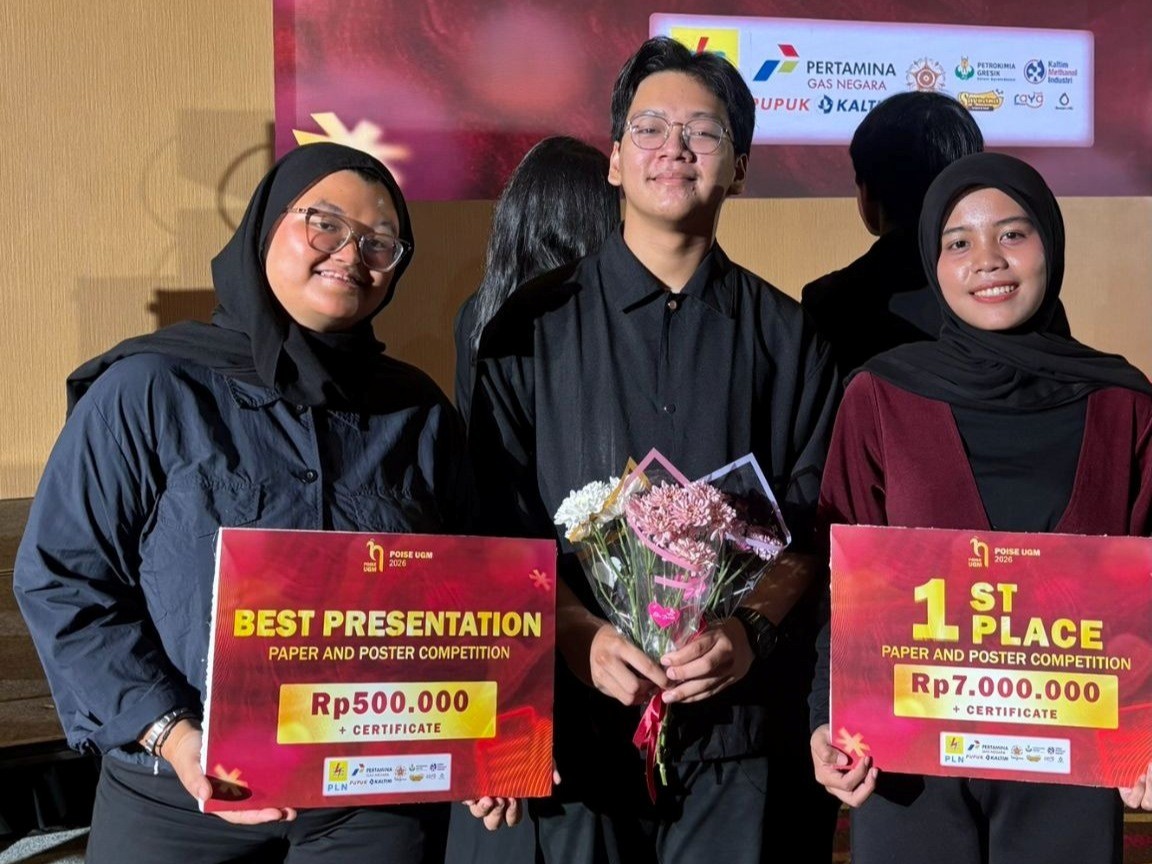
ITB students won first place in the Paper and Poster Competition category at POISE UGM 2026, held at the Faculty of Engineering, Universitas Gadjah Mada, Yogyakarta, on Saturday (October 24, 2026).
YOGYAKARTA, itb.ac.id – Three students from Institut Teknologi Bandung (ITB) have developed CarbonBridge, an innovative concept for modifying methanol production processes by utilizing palm oil mill effluent and green hydrogen as alternatives to fossil-based feedstocks. The innovation offers a potential solution to the methanol industry's dependence on natural gas while creating opportunities to transform palm oil waste into valuable chemical products. The concept earned the team first place in the Paper and Poster Competition (PPC) at POISE UGM 2026, held at Universitas Gadjah Mada, Yogyakarta, on Saturday (October 24, 2026).
The team consists of Nina Khoirunnisa Naila Wijaya, Nasywa Jilan Fashihah, and Glenn Immanuel Aldevito Marpaung, all Chemical Engineering students from the class of 2023. Organized by the Chemical Engineering Student Association of Universitas Gadjah Mada (KMTK UGM), the competition challenged participants to identify industrial problems and propose innovative solutions supported by scientific analysis. In addition to securing first place, the team received the Best Presentation award.
CarbonBridge: Integrating Palm Oil Waste into Methanol Production
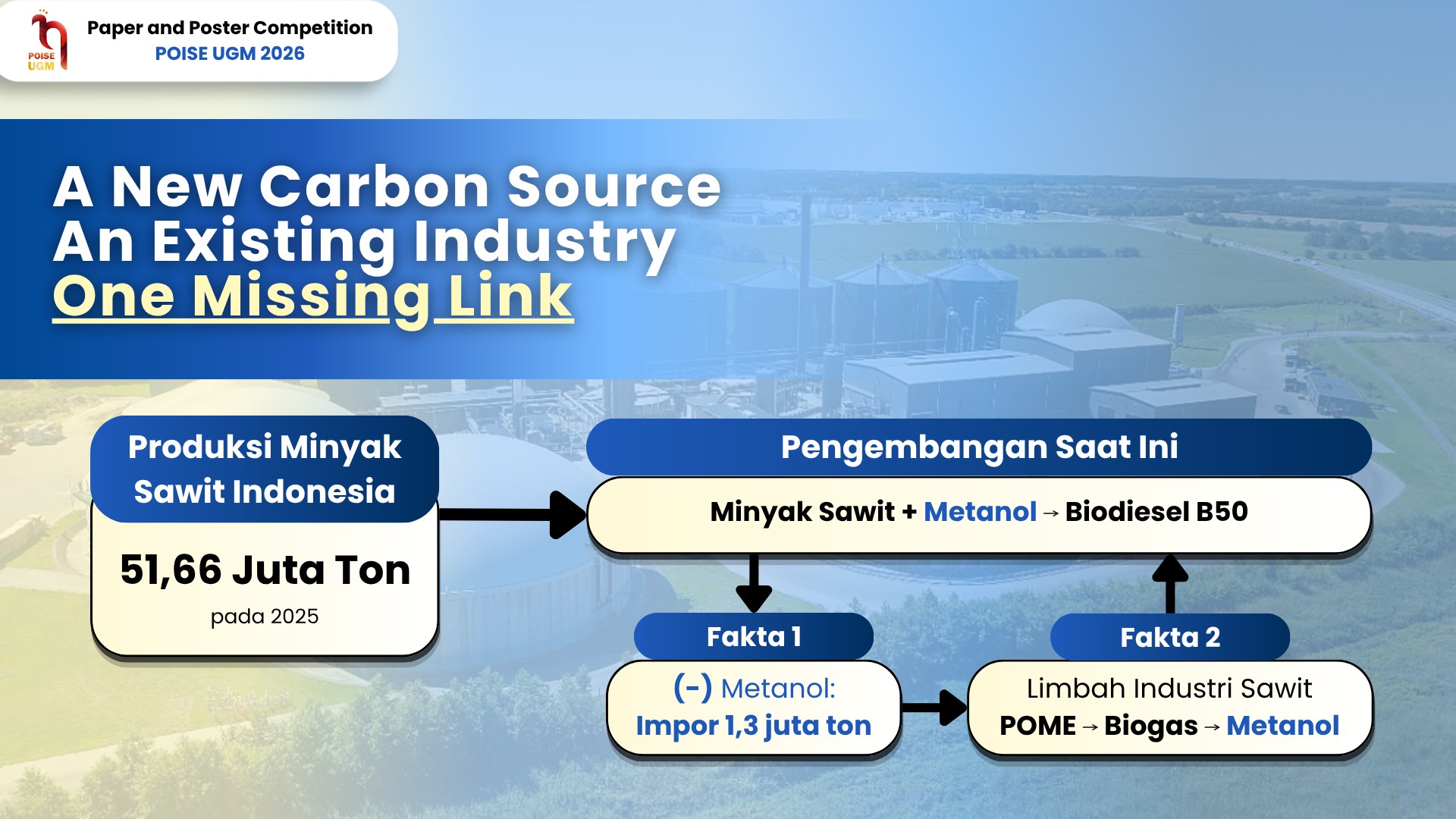
Illustration of the potential utilization of palm oil mill effluent (POME) as a source of biomethane to support methanol production through CarbonBridge, an innovation developed by the ITB student team for POISE UGM 2026. (Courtesy of the Team)
CarbonBridge is designed to retrofit existing methanol production facilities by integrating biomethane derived from palm oil mill effluent (POME) and green hydrogen into the production process. This approach enables the use of alternative feedstocks without requiring the construction of entirely new production facilities.
The concept was developed in response to several challenges facing Indonesia, including its reliance on methanol imports, constraints on natural gas availability, and the substantial potential of organic waste from the palm oil industry that remains underutilized.
"We chose this topic because we wanted to develop an innovation relevant to Indonesia's industrial conditions. As one of the world's largest palm oil producers, Indonesia has significant potential to utilize organic waste as an alternative source of energy and feedstock," Nina said.
Technically, CarbonBridge employs combined reforming technology to convert biomethane derived from POME, together with green hydrogen, into synthesis gas (syngas), a key feedstock for methanol production. The process incorporates Sorption-Enhanced Reforming (SER) and Adaptive Sorption Combined Reforming (ASCR) technologies, designed to improve feedstock utilization and produce syngas that meets the requirements of methanol synthesis units.
The proposed design takes into account the readiness of existing infrastructure, energy requirements, economic feasibility, and environmental impacts to enhance its potential for industrial application.
Assessing Technological Feasibility through Simulation and Environmental Analysis
To assess the feasibility of CarbonBridge, the team simulated four process scenarios using Aspen Plus software. The simulation results were used to evaluate technical performance, supply chain projections, economic feasibility, and greenhouse gas emissions through Life Cycle Assessment (LCA-GHG), as well as to develop an implementation roadmap.
One of the main challenges in developing the innovation was ensuring that all aspects of the design were consistently integrated. Changes to the process configuration could affect energy requirements, production costs, and environmental impacts, making comprehensive evaluation essential.
The analysis revealed that using renewable feedstocks does not necessarily result in lower emissions. Energy consumption and utility requirements throughout the production process can still contribute significantly to greenhouse gas emissions.
"Based on our analysis, using renewable feedstocks does not automatically lead to lower emissions, as energy and utility requirements throughout the process still contribute to overall emissions," Glenn said.
These findings served as a basis for refining the CarbonBridge design. The team emphasized that the sustainability of chemical manufacturing should be evaluated across the entire production process rather than solely based on the type of feedstock used.
Creating Opportunities for Industrial Integration and a Circular Economy
The development of CarbonBridge highlights opportunities for collaboration between the palm oil and chemical industries to generate added value from waste. With further development, the concept could support the diversification of methanol feedstocks, promote the utilization of local resources, and contribute to more sustainable industrial processes.
CarbonBridge is currently at the conceptual design and simulation stage. Therefore, its technical, economic, and environmental benefits require further validation before the technology can be implemented on an industrial scale.
"We hope CarbonBridge can serve as a reference for developing more sustainable methanol production technologies, particularly through the utilization of waste from the palm oil industry," Nasywa said.