Two Generations of Dedication: Father and Son, Both ITB Lecturers, Receive Awards at the 67th Dies Natalis
By Anggun Nindita
Editor Anggun Nindita
.jpeg)
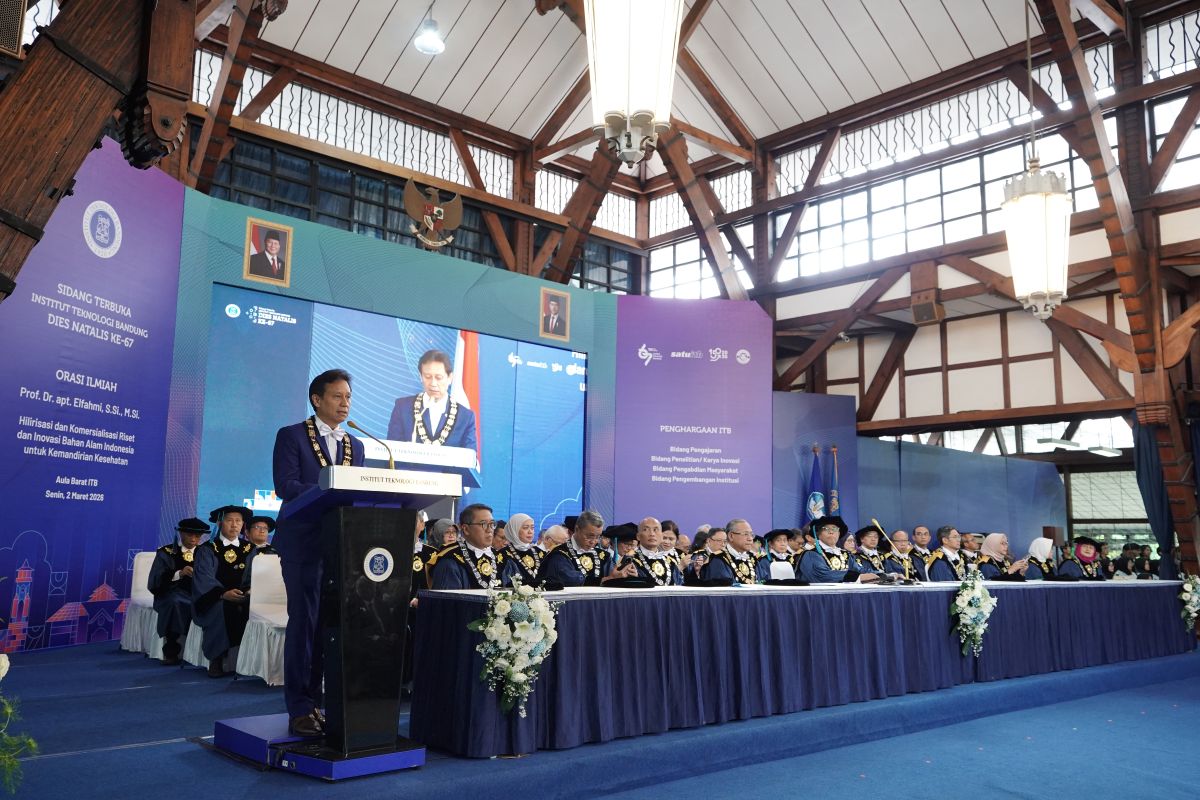
BANDUNG, itb.ac.id – The Open Senate Session of the 67th Dies Natalis of the Institut Teknologi Bandung (ITB), held on Monday (2/3/2026) at the West Hall of the ITB Ganesha Campus, presented a warm and meaningful story. It was not only about academic achievement, but also about a journey of dedication within a family.
On this occasion, two ITB lecturers from different generations, father and son, received awards simultaneously. Dr. Hakim Luthfi Malasan, M.Sc., a lecturer from the Astronomy Research Group at the Faculty of Mathematics and Natural Sciences (FMIPA) ITB, received an award in the Teaching category. Meanwhile, his son, Prananda Luffiansyah Malasan, S.Ds., M.Ds., Ph.D., a lecturer from the Human and Industrial Product Design Research Group at the Faculty of Art and Design (FSRD) ITB, received an award in the Research/Innovation category.
Receiving the awards together became an emotional experience for both of them.
Prananda said he felt both happy and deeply touched. For him, the moment became even more meaningful because he could share the recognition with his father.
“I feel happy and touched because this year I happened to receive the award together with my father. We also dedicate this award to my late mother,” he said.
He added that the moment became even more touching when he saw his father carrying a photo of his mother while receiving the award. For Prananda, the recognition was not only about professional achievement, but also about a family journey filled with support.
Research Rooted in the Community
As a researcher in design and social innovation, Prananda emphasized that research cannot be separated from education and community engagement. According to him, research should not only produce high academic quality but also create tangible impacts for society.
In his research process, he always involves students as part of the research team. This approach provides students with real learning experiences.
“This research award is not only for me, but also for the students and fellow educators involved in the research process,” he said.
With an academic background that combines design and anthropology, he often uses participatory approaches in developing social innovations. This approach invites communities to actively participate in the design process, ensuring that the resulting solutions truly match their needs.
Through this work, he has interacted with various communities across Indonesia, ranging from regions in Sumatra and rural areas of Java to indigenous communities in East Nusa Tenggara.
For Prananda, these experiences offer an important lesson: knowledge does not only emerge from campuses but also grows from the life of communities.
“I learn a lot from people in the community. Knowledge does not only exist on campus, but also beyond it,” he said.
He also emphasized that being both a lecturer and researcher should be driven by passion and sincerity. According to him, dedication carried out sincerely will naturally bring impact and appreciation.
Teaching as a Process of Experience
.jpeg)
Meanwhile, for Dr. Hakim Luthfi Malasan, receiving the teaching award was a deeply meaningful moment—especially as it came close to his retirement after more than three decades of service at ITB.
“This is an appreciation from ITB that I truly value, especially as I approach my retirement,” he said.
As an astronomy lecturer, he emphasized that learning cannot rely solely on listening to explanations in the classroom. Students need to be directly involved in the learning process.
He promotes the philosophy of learning by doing—learning through direct experience. According to him, this approach helps students understand knowledge more deeply.
“Students should not only listen, but also see and do. By doing, they will better understand what they are learning,” he explained.
He also stressed the importance of critical thinking and understanding processes. Amid rapid technological development and the rise of artificial intelligence, students need deeper thinking abilities rather than merely obtaining instant answers.
ITB as a Home
For Dr. Hakim, ITB is not merely a workplace. For more than 30 years, the campus has been an integral part of his life journey.
He has spent much of his time at the Bosscha Observatory, one of ITB’s astronomy laboratories located in Lembang. The observatory’s calm environment, far from the bustle of the city, has been an important place in shaping his scientific character.
There, he developed the scientific mindset that later connected him with the international scientific community.
“ITB has been my home for more than 30 years,” he said.
According to him, teaching is essentially a process of accompanying students in their learning journey. Lecturers are not merely conveyors of knowledge, but mentors who share experiences and perspectives.
He noted that ITB students possess strong learning abilities. Therefore, lecturers need to create spaces for dialogue and shared experiences to make the learning process more dynamic.
Cross-Generational Dedication
The story of a father and son receiving awards together at the 67th Dies Natalis of ITB symbolizes cross-generational dedication in academia.
One has built a long legacy in teaching, while the other continues contributing through research and social innovation.
Both demonstrate that knowledge does not only grow within classrooms or laboratories, but also through interactions with people, communities, and life experiences.
Behind these awards lies a long journey of sincerity, learning, and commitment to continuously contribute meaningfully to education and society.
.jpg)
.jpg)
.jpg)
.jpg)