Scientific Oration Prof. Rachmat Mauludin: Nanocrystals-Nanosuspensions for the Improvement of Physicochemical Properties of Active Pharmaceutical Ingredients
By Aura Salsabila Alviona - Mahasiswa Bioteknologi, 2025
Editor M. Naufal Hafizh, S.S.
.jpg)
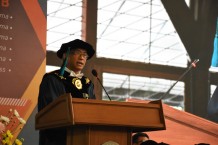
BANDUNG, itb.ac.id - The Board of Professors of Institut Teknologi Bandung (ITB) held a Scientific Oration at the West Hall, Ganesha Campus, on Saturday (10/10/2026). On this occasion, Prof. Dr.rer.nat. apt. Rachmat Mauludin, S.Si., M.Si. from the ITB School of Pharmacy delivered a scientific oration highlighting the improvement of the physicochemical properties of active pharmaceutical ingredients through the utilization of nanoparticles, specifically nanocrystals and nanosuspensions.
Prof. Rachmat opened his oration by explaining a major challenge in the current pharmaceutical world. Approximately 70% of newly synthesized drugs indicate solubility issues, both in water and organic compounds. The poor solubility of these active pharmaceutical ingredients directly impacts the bioavailability of the drugs when consumed.
Solutions through Nanocrystal Technology
As an answer to this challenge, Prof. Rachmat introduced an innovation he referred to as a "smart approach," namely the production of nanocrystals. Nanocrystals are 100% pure active ingredients that are finely ground to nanometer sizes, dispersed in water, and stabilized.
.jpg)
He highlighted two nanocrystal production methods that have proven successful in the market: ball milling and high-pressure homogenization (HPH). With the second generation of HPH technology, known as Smart Crystal, the particle size can be further reduced to below 100 nanometers.
Benefits of Improved Solubility and Dose Efficiency
Reducing the size of active pharmaceutical ingredients into nanocrystals provides several advantages. First, there is a drastic increase in saturation solubility and dissolution rate. Second, the much larger particle surface area will increase the adhesiveness of the drug. The increasing number of contact points between nanoparticles and the gastrointestinal tract wall will drive a high concentration gradient, allowing the drug absorption process into the body to occur faster and more optimally.
.jpg)
"Economically, we can see a dose reduction, especially for potent drugs or highly expensive cancer medications," explained Prof. Rachmat.
He gave an example of the drug Fenofibrate. Thanks to nanocrystal technology, the tablet dose, which was initially 300 mg, can now be reduced to 145 mg while still providing an equivalent effect (bioequivalent). Besides being far more economical, the reduced dose circulating in the body also makes the drug relatively safer toxicologically.
Despite its promising potential, Prof. Rachmat emphasized the importance of evaluating the safety aspects of nanoparticle use. The safety level is determined by two main factors: the size and the biodegradability of its constituent materials in the body. Based on the nanotoxicology classification system, particles smaller than 100 nanometers made of non-biodegradable materials have the highest risk of toxicity, thus their use requires special supervision in the future.
Profile of Prof. Dr. Rachmat Mauludin
.jpg)
Born in Cimahi in 1973, Prof. Rachmat is an expert belonging to the Pharmaceutics Research Group, ITB School of Pharmacy. He earned his Doctoral degree from the Free University of Berlin, Germany, in 2009. Throughout his career, he has published dozens of international scientific papers, registered various intellectual property patents, and actively conducted community service in various remote areas of Indonesia such as Merauke.
Behind his high dedication to research, Prof. Rachmat is known for his unique, relaxed side, ranging from his hobby of playing Candy Crush to participating in running events like the Ultramarathon and Bandung Marathon amidst his busy schedule. At the end of his oration, he also shared an inspiring story about his struggles during his youth, where he persistently taught at a tutoring center to earn extra income to meet his daily food needs. It is a long journey of dedication that has now successfully led him to achieve the highest honorary title in the academic field.
.jpeg)
.jpg)
.png)
.jpeg)