SENTRI: A Smart Surveillance System for Early Detection of Violence in Public Spaces by ITB Students
By M. Naufal Hafizh, S.S.
Editor M. Naufal Hafizh, S.S.
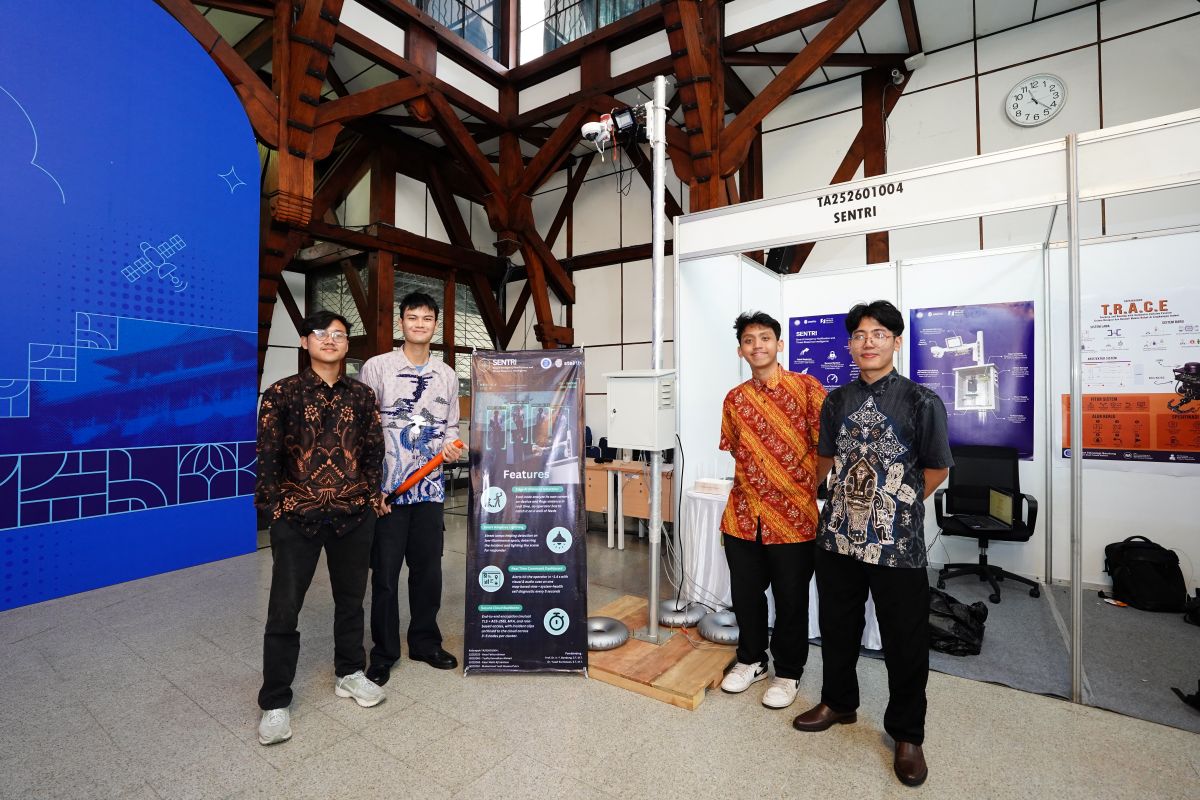
BANDUNG, itb.ac.id — Four students from the School of Electrical Engineering and Informatics (STEI) at Institut Teknologi Bandung (ITB) have developed SENTRI (Smart Emergency Notification and Threat Response Intelligence), a surveillance system based on artificial intelligence (AI) and edge computing that can visually and automatically detect indications of violence and send alerts to security officers. This innovation was showcased at Electrical Engineering Days 2026, which took place from June 22–25, 2026, in the East Hall, ITB Ganesha Campus.
SENTRI was developed to address the limitations of manual CCTV monitoring amidst the numerous public space surveillance points and the increasing need for rapid response to street violence. This system is designed as a modular device that can be integrated with existing CCTV infrastructure, allowing command center operators, security personnel, area managers, and even public users of public spaces to benefit from a more active and responsive surveillance system.
Through AI processing directly on the device, SENTRI can recognize movement patterns that indicate violence, send notifications with incident footage, and assist officers in verifying the situation before determining a response. This approach is expected to transform CCTV from a passive recording device into an early detection system that helps accelerate threat identification and action in the field.
This innovation plays a role in road safety, residential areas, offices, and other public spaces, directly impacting the public's quality of life.
By leveraging existing infrastructure and edge computing technology, SENTRI offers an approach that has the potential to strengthen security systems without having to build an entire surveillance infrastructure from scratch.
The SENTRI development team consists of Anas Fathurrahman, Taufiq Ramadhan Ahmad, Kean Malik Aji Santoso, and Muhammad Yaafi Wasesa Putra, with supervisors Prof. Dr. Ir. Y. Bandung, S.T., M.T., and Dr. Yusuf Kurniawan, S.T., M.T.
Integrated Modular Solution with the City's CCTV Network
SENTRI is designed with a modular concept, or as an add-on system, that can be integrated directly into the existing CCTV infrastructure in public areas in Bandung City. Therefore, the system's implementation does not require a complete overhaul of the camera infrastructure from scratch.
This system utilizes a specially trained artificial intelligence (AI) algorithm to map human gestures and movement patterns in real time.
1. Smart Movement Pattern Mapping: Artificial intelligence reads hand positions and body movement patterns. If the identified movements match a dataset of assaults or physical violence, the system will instantly detect the threat level.
2. Instant Notification and Footage Preview: Officers at the command center will immediately receive a Danger Alert Notification along with a short footage of the incident within seconds.
"This system can help ensure surveillance is not entirely dependent on operators who must monitor multiple cameras simultaneously. When a pattern indicating violence is detected, the system can issue an alert so officers can verify and respond more quickly," said Taufik Ramadhan Ahmad.
3. Validation Free from False Reports: The live video footage playback feature makes it easier for officers to accurately verify field conditions to avoid responding to prank calls or false reports.
Development Flexibility for Various Areas
Although developed for pedestrian areas in public spaces, SENTRI offers high flexibility. With AI algorithm adjustments, this system has the potential to be applied in private residential areas (real estate) and office complexes.
"Technically, the basic device is the same, just adjust the algorithm. In the future, this system can be developed to detect trespassing, unauthorized fence climbing, and even acts of vandalism," said Taufik Ramadhan Ahmad.
Generally, SENTRI consists of two parts. First, the hardware, in the form of cameras, that record conditions in public spaces and are equipped with additional sensors. Second, the information system that receives identification results and distress signals from devices in the field.
This information system is equipped with a dashboard that operators can use to monitor the condition of public spaces. Meanwhile, the technical team can use it to monitor the health and condition of the devices.
Based on development results presented at EE Days 2026, SENTRI achieved 60% pipeline accuracy on SCVD with a false positive rate of 14.3%. Demonstrated 98.20% accuracy for five-class classification using BiGRU and 91.90% for weapon detection.
The team also recorded a notification delivery time of approximately 1.36 seconds using the MQTT-based communication mechanism and the developed system protocol.
Through SENTRI, the ITB student team offers a new approach to public space surveillance systems. Cameras are no longer simply passive recording devices, but are integrated with artificial intelligence to help identify indications of violence and send alerts automatically.