Uncovering the Traces of Textile Dyes in the Citarum River: ITB Microbiology Students’ Research on Degrading Bacteria
By Dina Avanza Mardiana - Mahasiswa Mikrobiologi, 2022
Editor M. Naufal Hafizh, S.S.
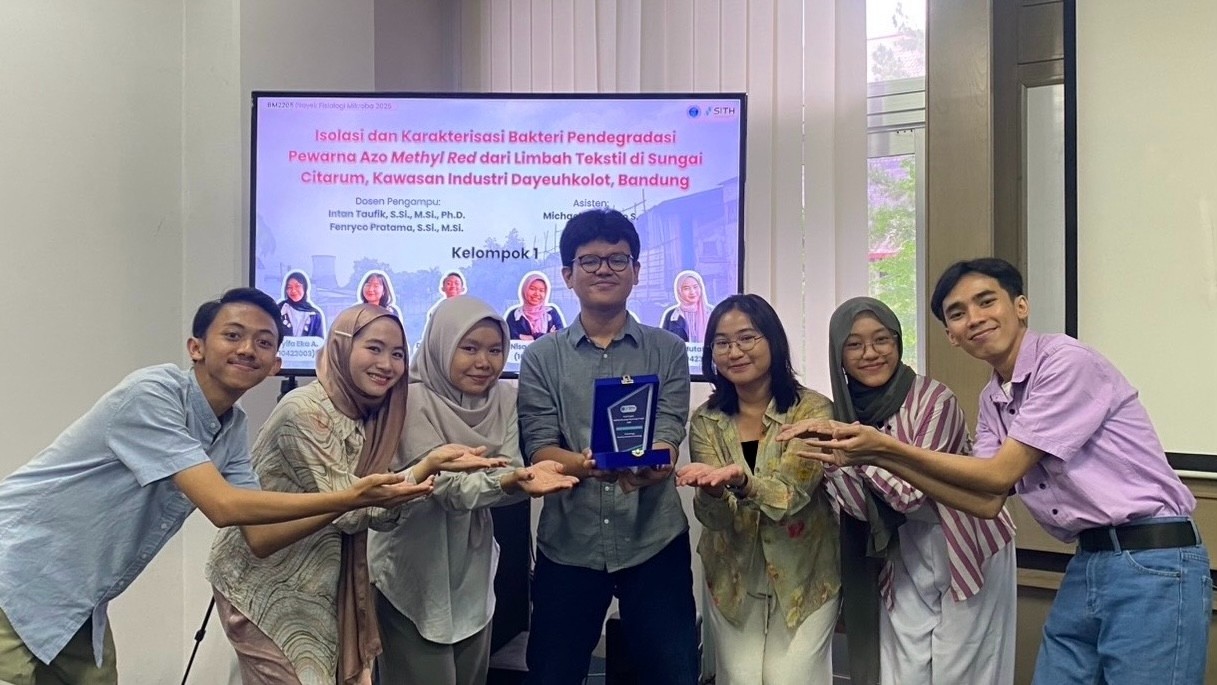
Among the various research topics proposed, one student group, namely Group 1, stood out with their research focusing on the isolation and characterization of methyl red-degrading bacteria from textile waste in the Dayeuhkolot area of Bandung. For their achievement, they were awarded Best Group in the 2025 Microbial Physiology Project course.
The group consisted of Asyifa Eka Agustin (10423003), Katarina Andrea Rismaputri (10423008), Dzakiy Muhammad Urwah (10423020), Nisa Arrifa Madyarina (10423034), Rifat Muhammad Zahran (10423040), and Haura Mutaharah Khoirun Nisa (10423048), under the guidance of assistant Michael Joseanto Sianturi (10422025). They chose to focus on methyl red because this synthetic dye is widely used in the textile industry and is known to be toxic to the environment. Through a bioremediation approach, they aimed to discover local bacterial isolates capable of degrading the compound efficiently and safely.
The research began with the collection of water samples from Dayeuhkolot. These samples were then activated in liquid media supplemented with methyl red to select bacteria capable of surviving or even degrading the compound. When cultured on solid media, several bacterial colonies formed clear zones around them, indicating degradation activity. The selected colonies were subsequently purified to obtain pure isolates and analyzed macroscopically and microscopically. Preliminary observations indicated that the isolates obtained were Gram-positive, rod-shaped bacteria.


The efficiency of methyl red degradation was then tested using spectrophotometry. Results showed that the selected isolate was able to degrade up to 82.88% of the dye within 36 hours. This percentage is relatively high compared to conventional methods, highlighting its promising potential for application in addressing environmental pollution caused by textile waste.
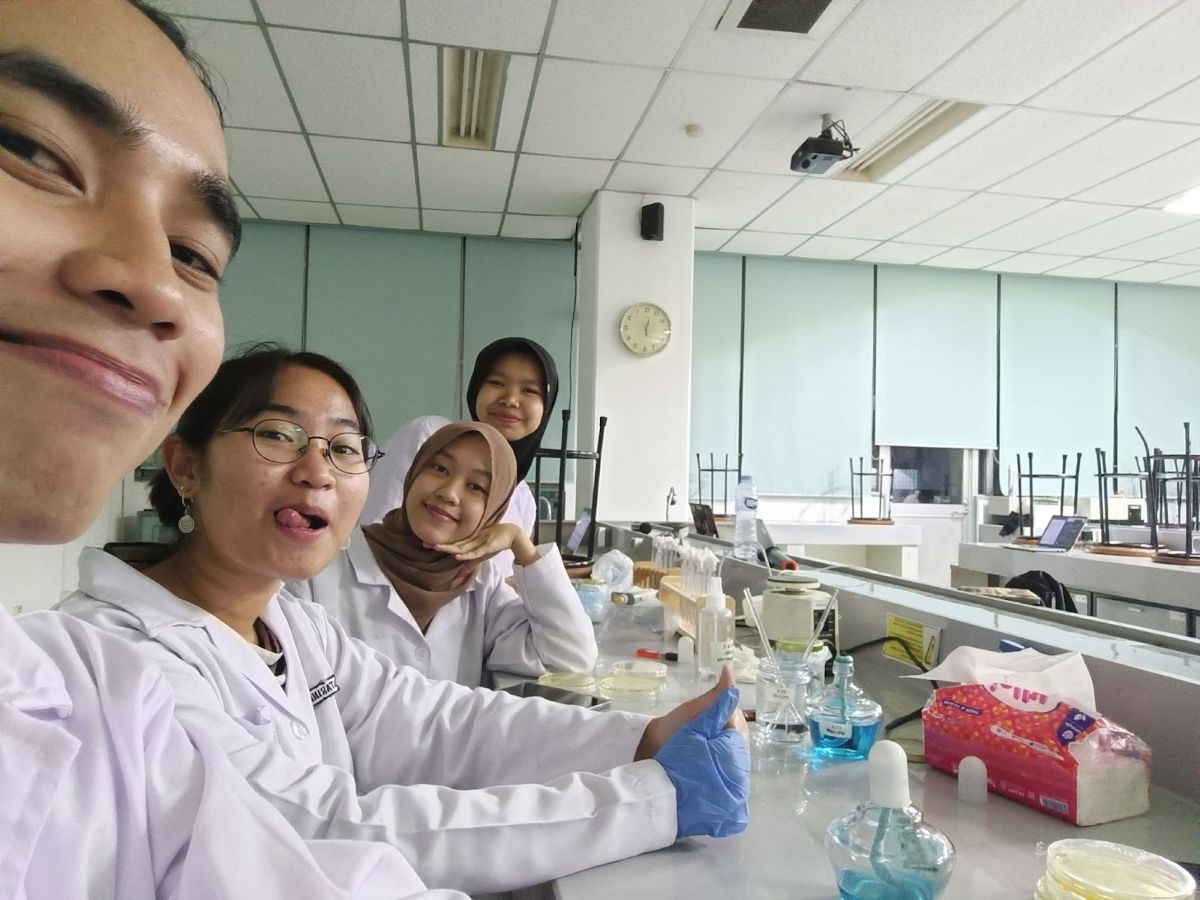
The entire research project spanned approximately one and a half months, starting with idea formulation in early May, laboratory experiments in mid-May, and data analysis in early June. The process required close collaboration among team members as well as laboratory skills sharpened through previous coursework and practical sessions.
Nisa, one of the group members, shared that the fundamental skills acquired from lectures and laboratory classes were invaluable. “From using laboratory equipment such as micropipettes and spectrophotometers, to seemingly simple technical skills like opening a falcon tube with one hand, everything proved crucial for the smooth execution of the research,” she explained.
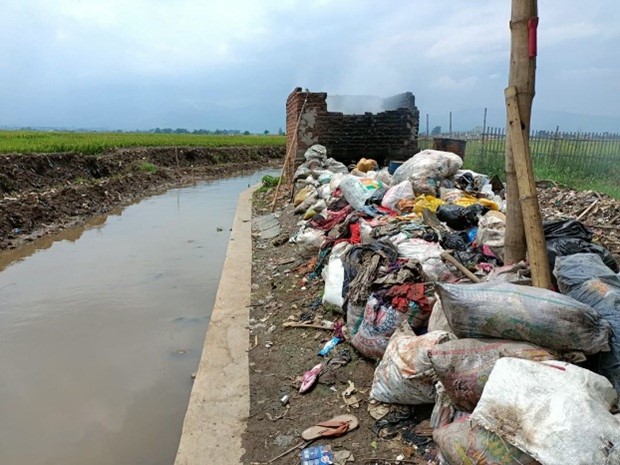
Nevertheless, the project was not without challenges. Access to textile industry waste was difficult to obtain due to the lack of official sampling permits. Dzaky explained that despite efforts to approach industry stakeholders, they were unable to secure permission to collect samples directly from factories. Additionally, the infrastructure at the sampling site posed difficulties, with narrow, unpaved roads limiting access. However, the team managed to overcome these obstacles by collecting samples from river streams located near residential areas.
Beyond its scientific contribution, the research also raised the students’ awareness of how microbiology can provide tangible solutions to real-world environmental problems. They hope similar research projects will continue to be developed, allowing students to apply their knowledge in practical contexts, and they also expressed hopes for continued improvement in laboratory facilities to further support the quality of student research.
Reporter: Dina Avanza Mardiana (Microbiology, 2022)
.jpg)
.jpg)
.jpg)
.jpg)