ITB Ranks 2nd in Indonesia and 56th Worldwide in THE Interdisciplinary Science Rankings 2027
By M. Naufal Hafizh, S.S.
Editor M. Naufal Hafizh, S.S.
BANDUNG, itb.ac.id – Institut Teknologi Bandung (ITB) ranked second in Indonesia and 56th worldwide in the Times Higher Education (THE) Interdisciplinary Science Rankings 2027, announced on Wednesday (November 18, 2026). ITB achieved an overall score of 68.4 in the rankings, which assessed 1,058 universities across 102 countries and territories. This achievement highlights ITB's position in advancing interdisciplinary research, which plays a vital role in fostering innovation and addressing various societal challenges.
Organized by Times Higher Education in collaboration with Schmidt Science Fellows, the rankings evaluate universities' contributions and commitment to supporting interdisciplinary research. The assessment considers the quantity and quality of research outputs, funding, facilities, institutional support, and university reputation in fostering collaboration across academic disciplines.
According to Prof. Dr.Eng. Suprijadi, M.Eng., Head of ITB's Quality Assurance Unit (SPM), "In these rankings, ITB received a score of 89.1 for inputs (research funding support), 50.0 for process (research support and governance), and 66.9 for outputs (research outcomes and quality). Among these three dimensions, inputs received ITB's highest score."
The THE Interdisciplinary Science Rankings specifically measure universities' contributions to research that integrates multiple scientific disciplines. This approach is particularly relevant to addressing complex challenges, such as climate change, energy security, healthcare, and industrial transformation, which require solutions drawing on diverse areas of expertise.
Under THE's methodology, interdisciplinary research encompasses collaboration across scientific fields, including computer science, engineering, life sciences, and physical sciences, which may also be integrated with social sciences and health-related disciplines. The rankings draw on several data sources, including information submitted by universities, scientific publication and citation data from Elsevier, and international academic reputation surveys.
To assess research quality, THE uses field-weighted citation impact indicators. This method evaluates the influence of scientific publications on research advancement, including how research findings are utilized across different disciplines. THE also conducted a reputation survey in 2026, involving active researchers to identify universities recognized for their strong institutional support and reputation in interdisciplinary research.
Cross-Disciplinary Collaboration to Advance Impactful Research
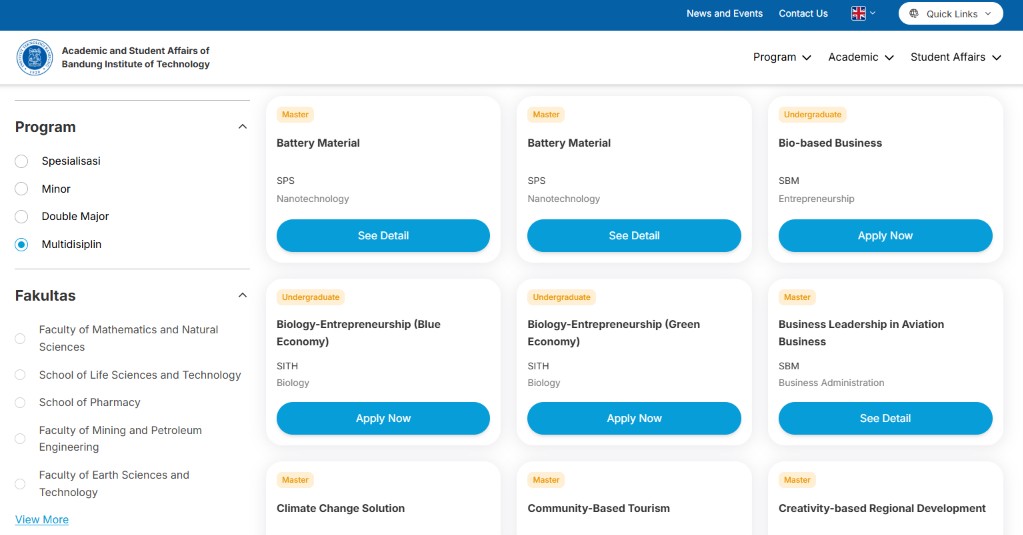
ITB's commitment to strengthening interdisciplinary collaboration is also reflected in its multidisciplinary education programs at both undergraduate and postgraduate levels.
ITB offers 63 multidisciplinary programs, providing students with opportunities to explore and integrate knowledge from various academic disciplines in line with evolving competency requirements and future challenges.
At the undergraduate level, several multidisciplinary programs are offered within ITB's School of Life Sciences and Technology (SITH), including Oceanography and Marine Biology, Biology–Entrepreneurship (Green Economy), and Biology–Entrepreneurship (Blue Economy). These programs integrate life sciences with marine studies, entrepreneurship, and economic development based on natural resources.
At the postgraduate level, ITB offers a range of multidisciplinary programs, including Climate Change Solution at the Faculty of Earth Sciences and Technology (FITB); Smart-X at the Faculty of Industrial Technology (FTI) and the School of Electrical Engineering and Informatics (STEI); Digital Technopreneurship and Digital Media Design at STEI; as well as Creativity-Based Regional Development and Sustainable Biodiversity Tourism at the School of Architecture, Planning and Policy Development (SAPPK).
The diversity of these programs reflects ITB's efforts to develop a collaborative research ecosystem, both across academic disciplines and through partnerships with government institutions, research organizations, and industry.
ITB's achievement in the THE Interdisciplinary Science Rankings 2027 serves as an important indicator of its continued progress in strengthening an interdisciplinary research ecosystem within the university.
Through an interdisciplinary approach, ITB aims to advance scientific knowledge while fostering the development of technologies, innovations, and policy recommendations that can be applied to address development challenges.