ITB Students Design B50 Fuel System for Ferries Without Dry Docking, Win First Place in National Competition
By Rasya Ihza Ramadhan - Mahasiswa Teknik Fisika, 2023
Editor M. Naufal Hafizh, S.S.
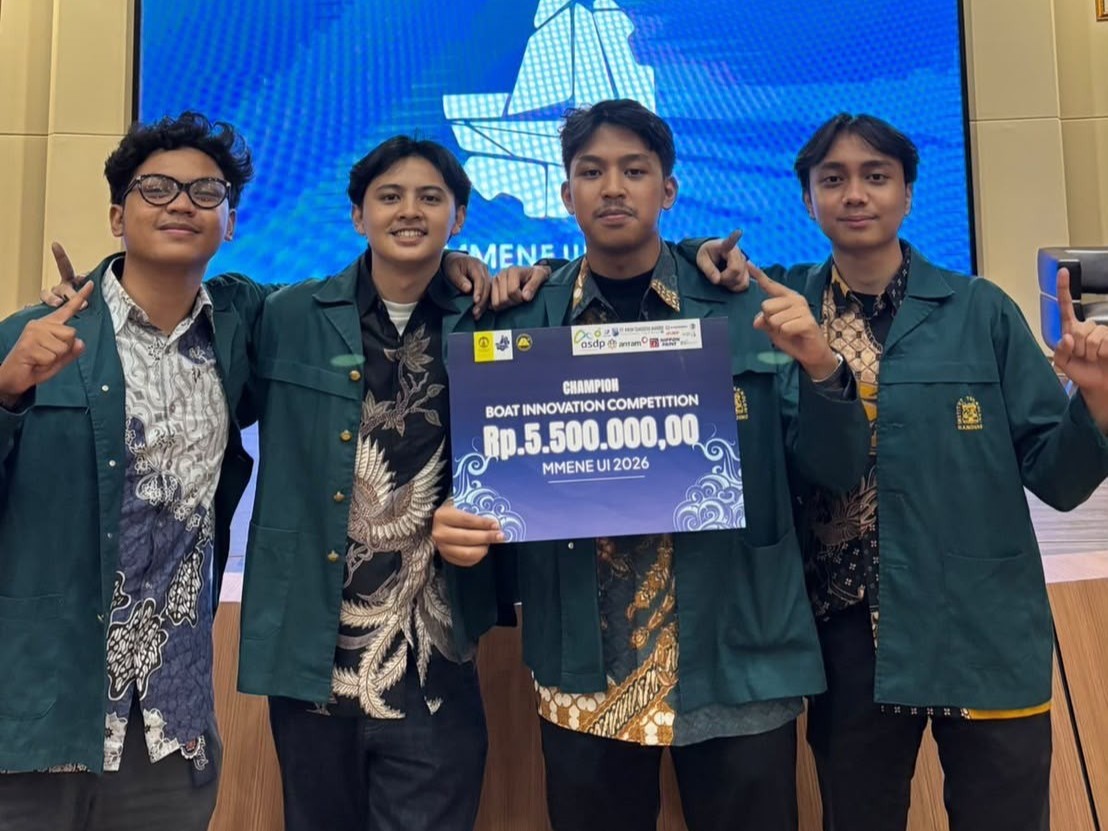
The Top 1 Dinamika Jatiwaringin team won first place in the Boat Innovation Competition (BIC) at the 2026 Mechanical and Marine Engineering National Exposition (MMENE UI), organized by the Mechanical Engineering Student Association of Universitas Indonesia in Depok on Saturday (October 24, 2026). (Courtesy of the Team)
DEPOK, itb.ac.id – Four students from Institut Teknologi Bandung (ITB) have designed a B50 biodiesel fuel quality control system that enables ferries to adapt to the use of the fuel without undergoing dry docking. The innovation aims to reduce the risk of engine failures caused by fuel contamination while minimizing disruptions to vessel operations. The proposed system has the potential to improve ferry service reliability, enhance passenger safety, and support the transition toward more sustainable fuels.
The innovation earned the ITB student team first place in the national Boat Innovation Competition (BIC) at the 2026 Mechanical and Marine Engineering National Exposition (MMENE UI), held at Universitas Indonesia, Depok, on Saturday (October 24, 2026).
Competing under the name Top 1 Dinamika Jatiwaringin, the team consisted of Kresno Bayu Aditya Seno, Arvy Fadhil Firansyah, Ananda Ghibran Fadlilah, and Haroki Taqiyyudin Robbani. All four are students from the 2023 cohort of the Mechanical Engineering Undergraduate Program, Faculty of Mechanical and Aerospace Engineering (FTMD ITB).
Developing a System to Maintain B50 Fuel Quality
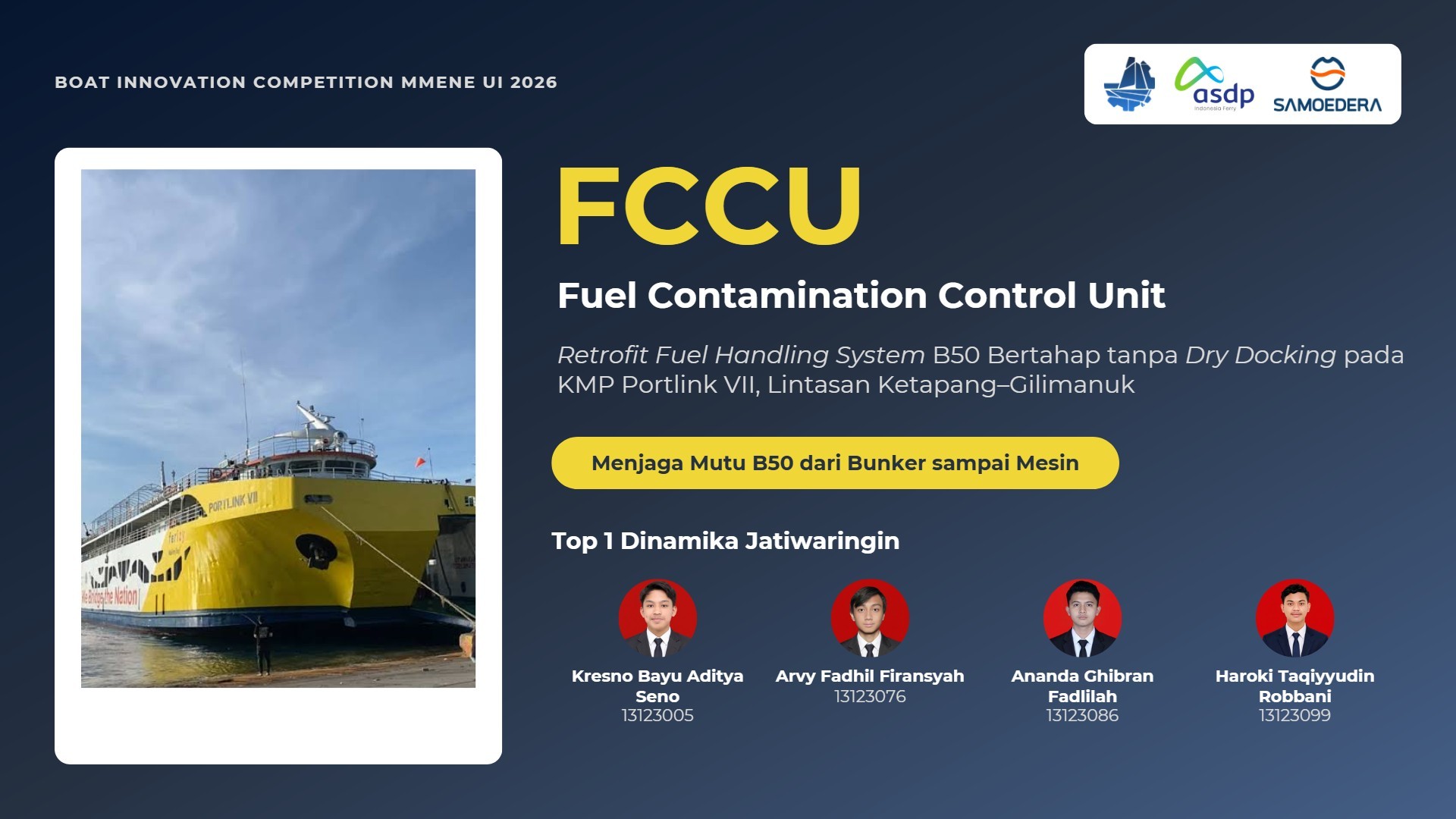
Opening slide of the team's presentation titled “FCCU Retrofit Fuel Handling System B50 Bertahap tanpa Dry Docking pada KMP Portlink VII, Lintasan Ketapang-Gilimanuk,” Saturday (October 24, 2026). (Courtesy of the Team)
The ITB team developed a Fuel Contamination Control Unit (FCCU), a system designed to remove contaminants and maintain fuel quality aboard KMP Portlink VII, a ferry operating on the Ketapang–Gilimanuk route.
The system is intended to support the use of B50 biodiesel, a fuel blend consisting of 50 percent Fatty Acid Methyl Ester (FAME), a plant-based biodiesel component, and 50 percent conventional diesel fuel.
The adoption of B50 presents particular challenges for ferries originally designed to operate on conventional diesel. FAME tends to absorb moisture, is susceptible to oxidation during storage, and can dissolve accumulated deposits in fuel tanks. These characteristics may lead to clogged filters and potentially disrupt engine performance.
KMP Portlink VII was selected as the case study because of its relatively short operating route, covering approximately 2.8 nautical miles with a crossing time of around 17 minutes. According to the team's calculations, filling both fuel tanks simultaneously could result in fuel being stored for 26–36 days. Prolonged storage, particularly in humid marine environments, may accelerate the deterioration of B50 fuel quality.
“If a vessel's fuel handling system is not adapted for B50, sudden filter blockage could cause the main engine to shut down, resulting in a loss of propulsion while the vessel is navigating the shipping channel,” Kresno explained.
To address these challenges, the team designed the FCCU around four main control mechanisms: preventing moisture ingress, separating contaminants, maintaining uninterrupted filtration, and managing fuel storage duration.
Moisture prevention is achieved through the installation of silica gel desiccant breathers on the fuel tanks. A combination of separators and coalescers is then used to remove solid particles and water from the fuel.
The system also incorporates duplex filters with an automatic switching mechanism, allowing filtration to continue through a standby filter when the other requires replacement. This ensures uninterrupted fuel flow during filter maintenance.
Additionally, the team proposed an alternating bunkering strategy, which, according to their design calculations, could reduce fuel storage duration to approximately 14 days. The system is also equipped with water-content sensors and temperature controls that limit the maximum temperature to 50 degrees Celsius to reduce the risk of B50 degradation during operation.
A Retrofit Solution That Minimizes Disruptions to Ferry Operations
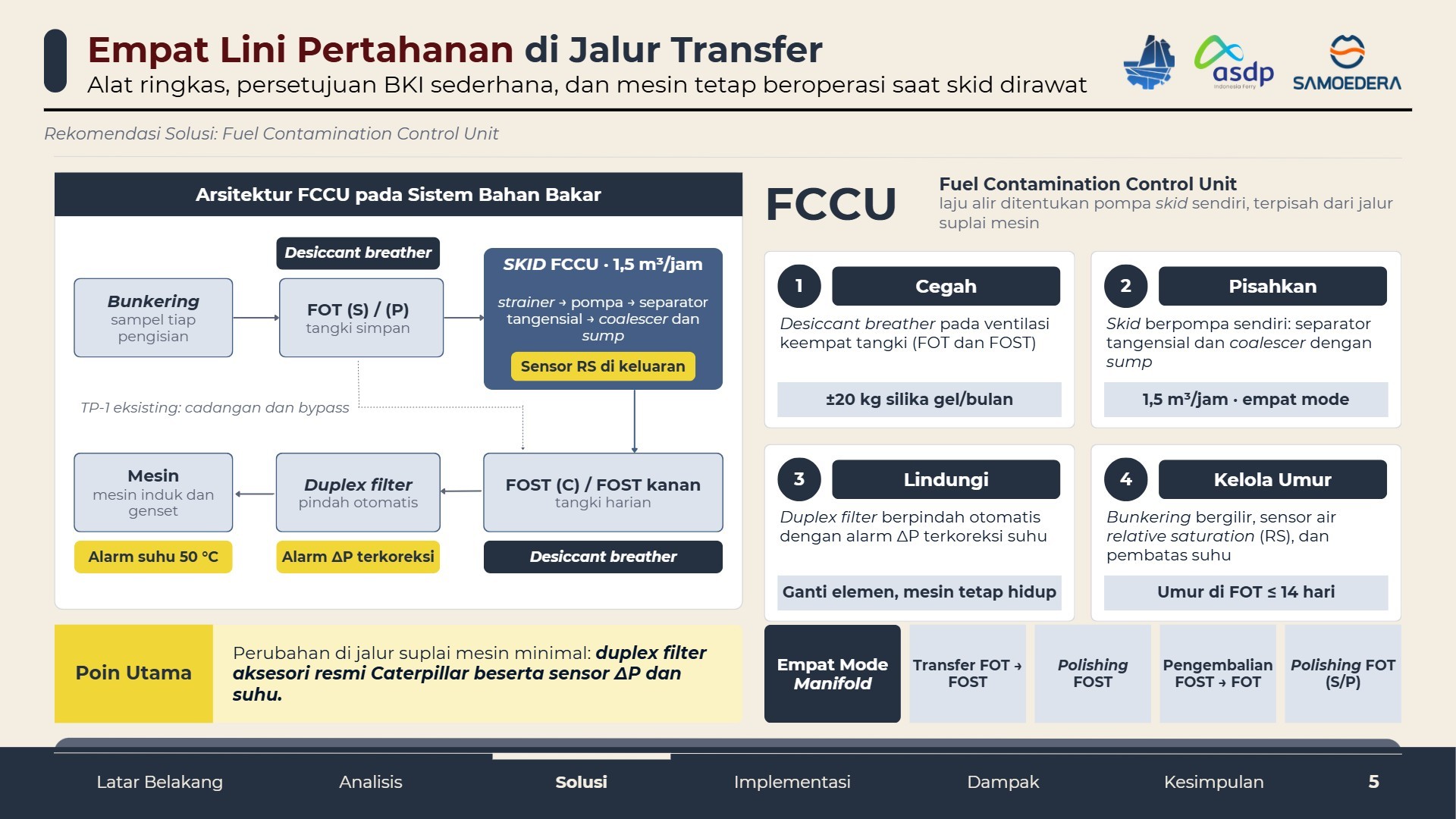
Design of the Fuel Contamination Control Unit (FCCU), featuring four lines of B50 biodiesel contamination control for ferries, Saturday (October 24, 2026). (Courtesy of the Team)
A key advantage of the FCCU design lies in its retrofit approach, which allows additional technology to be installed on an existing vessel without replacing the entire fuel system.
The FCCU is designed as a compact module measuring approximately 1.47 × 0.97 × 1.54 meters, with an operating weight of around 526 kilograms. Its relatively compact dimensions allow installation without modifying the main fuel supply line to the vessel's engine.
Installation is planned in six stages during the vessel's regular berthing periods. This approach would enable the fuel system to be upgraded without taking the ferry out of service for dry docking, thereby minimizing potential disruptions to scheduled crossings.
To assess the technical feasibility of the design, the team applied Failure Mode and Effects Analysis (FMEA) to identify potential system failures. They also developed three-dimensional models using SolidWorks and conducted Computational Fluid Dynamics (CFD) simulations to evaluate fuel flow characteristics and contaminant separation performance.
Beyond technical considerations, the team assessed economic feasibility through sensitivity analysis using Python and Monte Carlo simulations, a computational method used to estimate possible outcomes under various uncertainties.
“We conducted sensitivity analysis using Python and Monte Carlo simulations to evaluate technical and economic uncertainties. Based on our calculations, the FCCU design is projected to reduce the fuel system's failure risk score by 71 percent, with an estimated investment of approximately IDR 707 million and a payback period of 5.9 years under the base-case scenario,” Arvy said.
These results are projections based on design calculations and simulations, rather than findings from actual onboard testing.
During the design process, the team faced limitations in the availability of technical data for KMP Portlink VII. To address these constraints, they relied on existing technical documentation, established conservative design assumptions, and evaluated multiple scenarios to ensure that their calculations remained scientifically defensible.
“We reconstructed the system based on available technical documents, established a transparent and conservative set of design assumptions, and conducted sensitivity analyses and simulations across various scenarios to ensure that our design would remain robust when actual field data becomes available,” Haroki explained.
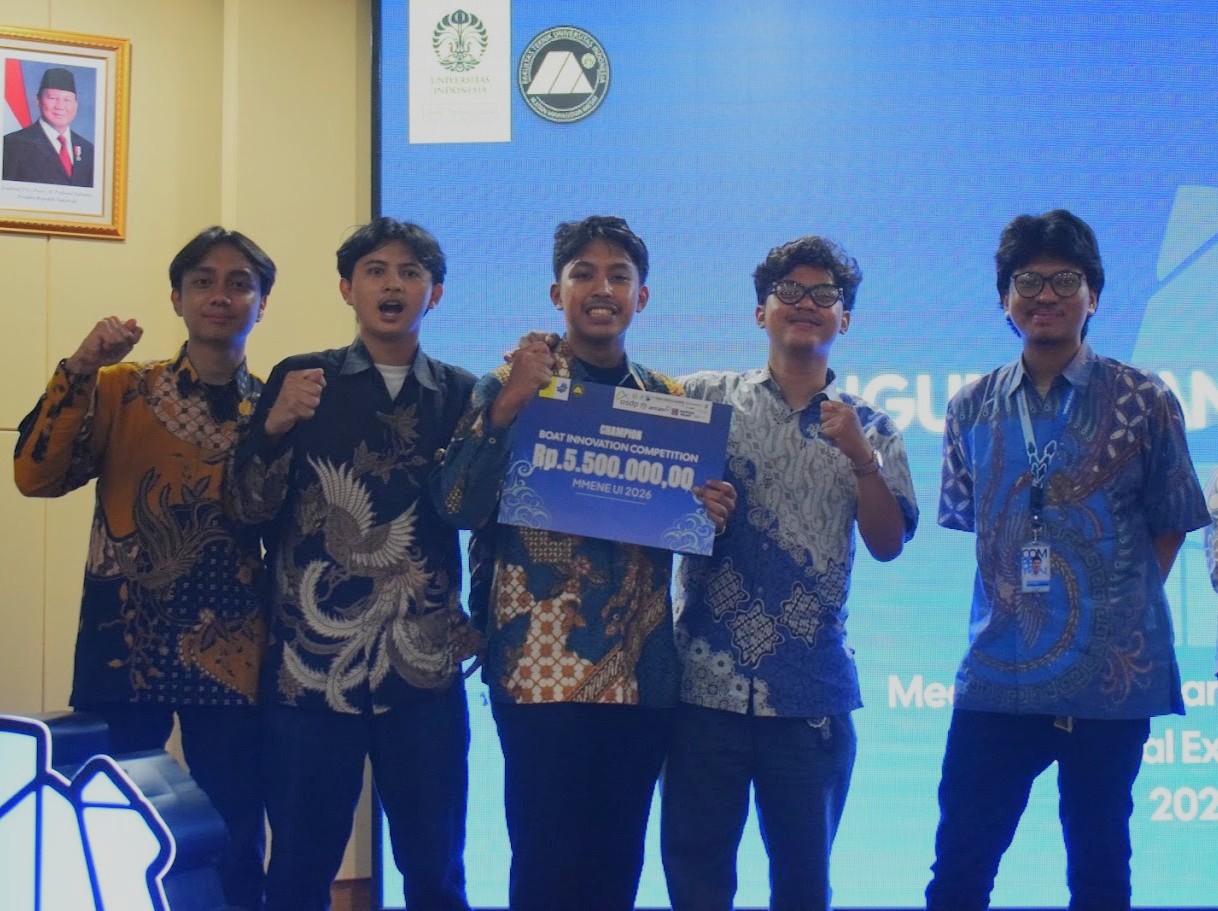
The Top 1 Dinamika Jatiwaringin team received the first-place award in the Boat Innovation Competition at MMENE UI 2026, held at Universitas Indonesia, Depok, on Saturday (October 24, 2026). (Courtesy of the Team)
Looking ahead, the team hopes to further develop the FCCU through an onboard survey of KMP Portlink VII, prototype testing using actual B50 biodiesel samples, and evaluations conducted in collaboration with industry partners to assess its readiness for implementation.
“We hope the FCCU design can be further developed through a direct survey of KMP Portlink VII, prototype testing using actual B50 biodiesel samples, and continued efforts to support the Indonesian shipping industry's readiness to transition toward more sustainable fuels while maintaining engine reliability, cost efficiency, and passenger safety,” Ghibran said.
This innovation represents one of the contributions of ITB students in developing engineering solutions that address the needs of the maritime transportation industry. By integrating safety, operational efficiency, and sustainability considerations, the proposed FCCU system has the potential to help Indonesia's ferry fleet prepare for the adoption of B50 biodiesel fuel.