ITB Students Win 1st Place in National Essay Competition Through NEXUS Innovation: AI-Driven Smart Carbon Management for Mature Oil and Gas Fields
By Rasya Ihza Ramadhan - Teknik Fisika, 2023
Editor M. Naufal Hafizh, S.S.
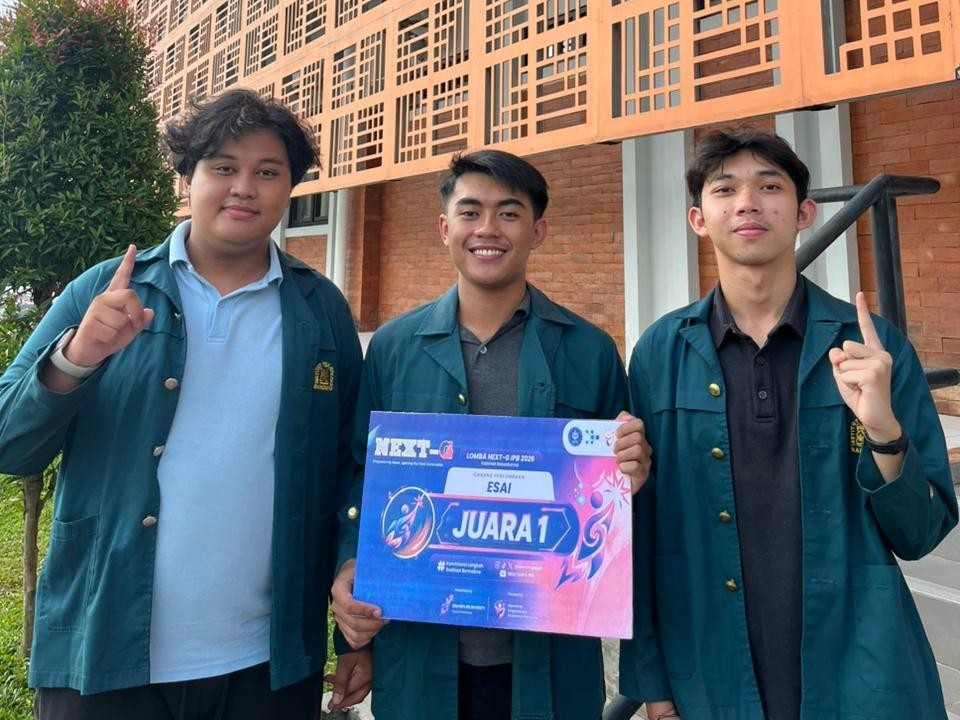
CIREBON, itb.ac.id – Two Industrial Engineering students and one Petroleum Engineering student from the Class of 2023 at Institut Teknologi Bandung (ITB), who are part of Team “PKWNK22,” won 1st place out of 47 finalists in the essay category at NEXT-G IPB 2026, organized by BEM FMIPA IPB.
The team presented an innovation that integrates nanotechnology, foam stabilization using nanohybrid Graphene Quantum Dots and nanosilica, and artificial intelligence to improve CO₂ storage efficiency while enhancing oil recovery in mature oil and gas fields through an adaptive and real-time carbon management system called NEXUS.
NEXT-G 2026 carried the theme “Green Industry: Innovation for Sustainable Energy Transition.” The competition challenged participants to present real solutions to issues related to energy and carbon emissions.
Team PKWNK22, consisting of Mahesya Friemay Romadhoni, Lukmanul Hakim, and Dhefa Mochamad Septiana F, introduced an innovation titled “NEXUS: AI-Driven Smart Carbon Management for the Decarbonization of Mature Oil and Gas Fields through NP-FAWAG.” In the competition, the team addressed this challenge by integrating CCUS, NP-FAWAG, nanohybrid Graphene Quantum Dots, nanosilica, Bayesian Optimization, Bi-LSTM, and an AI-based monitoring dashboard into one integrated system.
According to Mahesya, “We want to present a realistic energy transition solution for mature oil and gas fields while maintaining economic value and supporting the Net Zero Emission 2060 target.”
The development process of NEXUS required the team to balance knowledge from different academic disciplines. The team combined various fields of expertise to produce an effective system. “We worked 200%, read journals, developed ideas, and continued coordinating despite our busy academic schedules,” said Dhefa. They also made major revisions to the essay structure to ensure technical clarity and relevance.
The potential impact of NEXUS for Indonesia is significant. From an industrial perspective, this system can help oil and gas companies achieve high-efficiency decarbonization in an adaptive and economically valuable way through improved oil recovery and optimized CO₂ storage. From a societal perspective, NEXUS has the potential to reduce carbon emissions, support low-carbon industries, and improve public literacy on the green energy transition.
The team hopes that this system can be further developed through laboratory validation, field pilot projects, and industrial-scale implementation. They also hope it can be expanded to other high-emission sectors, such as petrochemicals, cement, and power generation.
“We hope this innovation will not stop as a competition paper, but can become a real smart carbon management system platform and encourage the development of AI, nanotechnology, and CCUS research in Indonesia so that it can become more globally competitive,” said Hakim.
Reporter: Rasya Ihza Ramadhan, Engineering Physics, 2023.
.jpg)
.jpg)
.jpg)
.jpeg)
.jpg)