Prof. Rildova's Scientific Oration: Understanding Offshore Structural Dynamics for Future Energy Infrastructure
By Azka Madania Nuryasani - Mikrobiologi, 2022
Editor M. Naufal Hafizh, S.S.

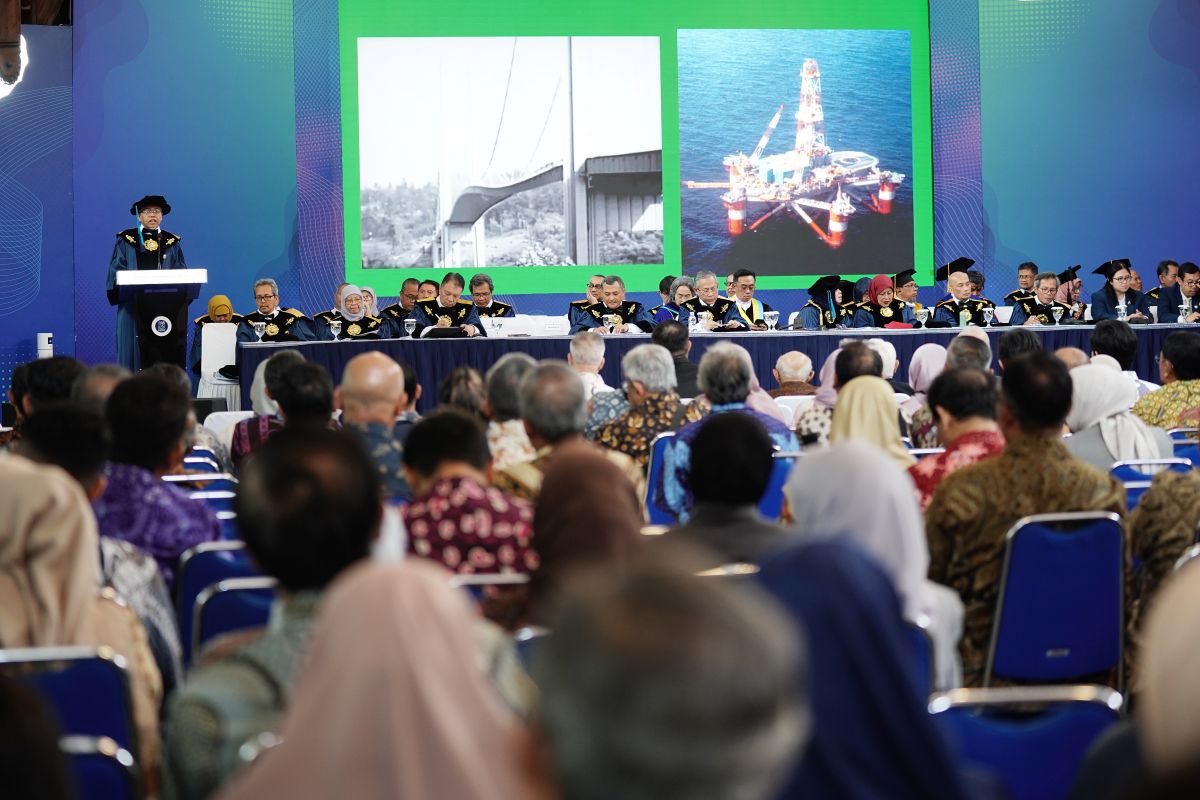
BANDUNG, itb.ac.id — Prof. Ir. Rildova, M.T., Ph.D., Professor at the Faculty of Civil and Environmental Engineering (FTSL), Institut Teknologi Bandung (ITB), delivered a scientific oration titled “Offshore Structural Dynamics: From Conventional Energy Infrastructure to Renewable Energy” at Aula Barat, ITB Ganesha Campus, on Saturday (6/12/2025).
Nearly all offshore structures are infrastructure related to energy extraction or generation at sea, particularly oil and gas platforms as part of conventional energy systems. However, as renewable energy continues to develop, supporting infrastructure for these technologies must also be prepared. In her oration, Prof. Rildova discussed offshore structures as a way to better understand structural dynamics and support the development of infrastructure for renewable energy.
Structural Dynamics and Offshore Structures
Structural dynamics is an extension of structural analysis concerned with determining how structures respond to dynamic loads, namely loads whose magnitude changes over time. From the perspective of structural dynamics, structural analysis that considers only static loads can be seen as a special case of dynamic loading.
According to Prof. Rildova, structural failure has often become the starting point for research in structural dynamics. Examples include the collapse of the Tacoma Narrows Bridge in 1940 due to wind, and the Alexander Kielland platform accident in the North Sea in 1980, which was caused by damage to a structural element and later triggered by wave loading. These cases demonstrate the importance of understanding structural dynamics.
“The collapse in this case showed that the source was a poorly designed detail that initiated cracking at that location. Then, due to continuous cyclic loading, even though the loads were not particularly large, the crack propagated to one of the braces below, specifically around the hydrophone support,” he said.
Problems in structural dynamics often arise not because of extremely large loads, but because ordinary loads act on a structure under resonance conditions. In offshore structures, the main dynamic loads are earthquakes, waves, wind, and the rotational loads of wind turbine blades.
In structural dynamics, engineers typically study dynamic amplification factor curves as a function of frequency ratio for various damping ratios. These curves show how structural response increases when the loading frequency approaches the structure’s natural frequency. In earthquake-resistant design, response spectra are used, as regulated in standards such as API for offshore platforms.
Controlling the Response of Offshore Oil and Gas Platforms
In the early years of platform construction, optimization was not a top priority because the value of oil outweighed the cost of the structure. Today, however, optimization has become essential. The most commonly used offshore oil and gas platforms in Indonesia are jacket-type platforms built from tubular steel, supported by three, four, or more legs, and piled into the seabed.
Efforts to control the dynamic response of structures can generally be divided into passive, semi-active, and active control methods. Passive vibration control for offshore structures has developed more extensively, involving the addition of control components that improve the structure’s dynamic behavior or absorb much of the damaging energy from environmental loads so that other structural elements are not adversely affected.
Passive response control techniques include tuned mass dampers (TMD), tuned liquid dampers (TLD), friction dampers (FD), fluid viscous dampers (FVD), viscoelastic dampers (VED), metallic dampers (MD), and dampers using inerters.
“The application of research results to offshore structures, both from our own work and from other researchers, is still largely at the stage of numerical studies and laboratory experiments. This means that direct field implementation remains very open and offers broad research opportunities,” Prof. Rildova said.
Offshore Wind Turbines and Floating Solar Panels as Renewable Energy Infrastructure
Prof. Rildova is also currently conducting research on offshore wind turbines and floating solar panels at sea. Offshore areas are considered ideal locations for wind power systems. The absence of land availability constraints, as well as the lack of obstacles to wind flow, are among the main advantages.
Prof. Rildova explained that, for renewable energy infrastructure, research is still ongoing to better understand connection behavior and structural durability. Meanwhile, the challenges in wave energy conversion technology are quite different. In conventional structures, engineers aim to minimize dynamic response as much as possible. In wave energy devices, however, a large response is actually required. With relatively small input waves, the device must be able to oscillate significantly in order to generate energy optimally.
.png)
.jpg)
.jpg)
.jpg)
.jpg)

.jpg)