Professor Sandro Mihradi’s Scientific Oration: Mechanics for Humanity
By Kayla Annisa Erian - Mahasiswa Rekayasa Infrastruktur Lingkungan, 2023
Editor M. Naufal Hafizh, S.S.
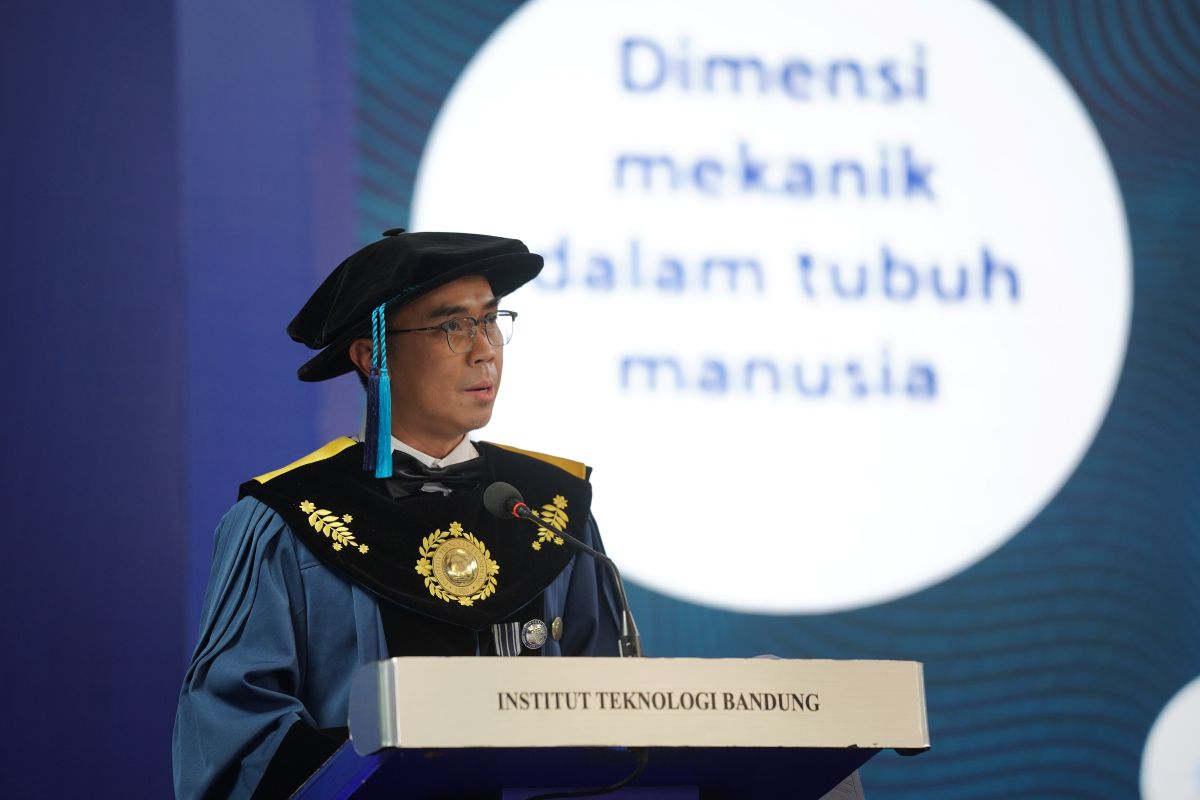
BANDUNG, itb.ac.id – The Forum of Professors at Institut Teknologi Bandung (ITB) held a Scientific Oration by a Professor at the West Hall, ITB Ganesha Campus, on Saturday, October 10, 2026. On this occasion, Prof. Dr.Eng. Sandro Mihradi delivered an oration entitled “Mechanics for Humanity: Transforming the Science of Mechanics into Healthcare Technology for Indonesia.”
Through his oration, Prof. Sandro explored how mechanics, the study of forces and motion, can be applied to understand the complexity of the human body and develop healthcare technologies. Drawing on his extensive experience in mechanics, he demonstrated how understanding human movement can serve as the foundation for developing medical devices that help restore bodily functions and improve patients’ quality of life.
Understanding Human Movement as the Foundation of Technology Development
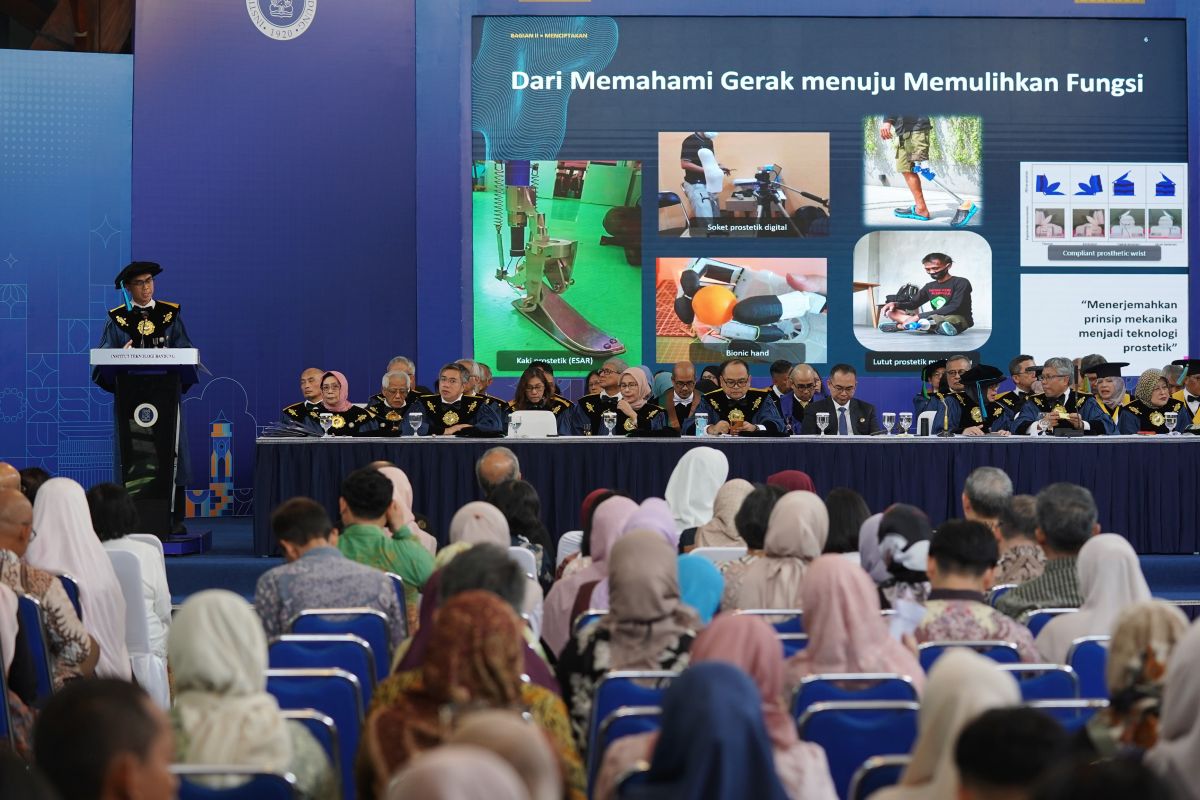
The development of healthcare technology begins with understanding human movement through modeling that represents the human body as a system of interconnected segments. Each segment is connected through joints, while its movement can be measured and analyzed to obtain various parameters that are valuable in medical applications.
One example is the development of prosthetic knee technology. The knee serves two functions that must work together: providing stability while allowing a high degree of mobility. Achieving both requires kinematic analysis and mechanism synthesis to understand and optimize knee movement.
Through modeling a four-bar linkage mechanism with optimized link lengths, knee movement can be represented and analyzed. Numerical analysis is then used to examine how the structure responds to loads and identify critical points. The results of modeling and simulation subsequently serve as the basis for prototype development, which undergoes testing before being used by patients.
For Prof. Sandro, the success of prosthetic technology cannot be measured solely by the completion of its design. Rather, its true value lies in the tangible benefits it provides to its users.
“Technology is not successful simply when its design is complete, but when it can help someone move as they did before,” said Prof. Sandro, explaining his research on prosthetic knees.
Technology Designed Around Users’ Needs
.jpg)
The development of prosthetic legs, bionic hands, and rehabilitation devices demonstrates that healthcare technology must be designed around the specific characteristics and needs of each user. Differences in the functions and complexity of individual body parts require tailored engineering approaches for each device.
Prosthetic technology is not intended merely to facilitate movement, but also to improve the ability of devices to respond to users’ needs and conditions. This approach is also applied in Rehab Bot, a rehabilitation robot designed to train muscle strength by providing virtual resistance adjusted to the load experienced by the leg.
Another example is the Digital Prosthetic Socket, a technology developed through a patient-specific approach. The socket is a crucial component of a prosthesis because it comes into direct contact with the user's body. Its design must therefore account for fit, comfort, and safety.
In developing these technologies, simulation and experimentation play complementary roles. Simulation is used to predict device performance, while experiments test and validate those predictions. However, in healthcare technology, a device's success must also be evaluated through user feedback to ensure its safety, comfort, and effectiveness in everyday use.
From Laboratory to Society: The Importance of an Engineering Ecosystem
.jpg)
The challenges of developing healthcare technology extend beyond design and testing. The COVID-19 pandemic provided a real-world example of the complexity involved in bringing technology from the laboratory to society.
As demand for ventilators increased dramatically within a short period, various stakeholders collaborated to develop respiratory support devices. The process involved not only device design and manufacturing, but also a series of tests, including functionality, endurance, and safety assessments. Clinical trials and compliance with manufacturing and distribution licensing requirements were also necessary to ensure that the devices could be used safely and in accordance with applicable regulations.
This experience demonstrated that healthcare technology development is a lengthy process that requires more than technical success alone. For innovations to deliver tangible benefits, an ecosystem must connect universities, educators and researchers, government institutions, regulators, industry, healthcare professionals, and the public.
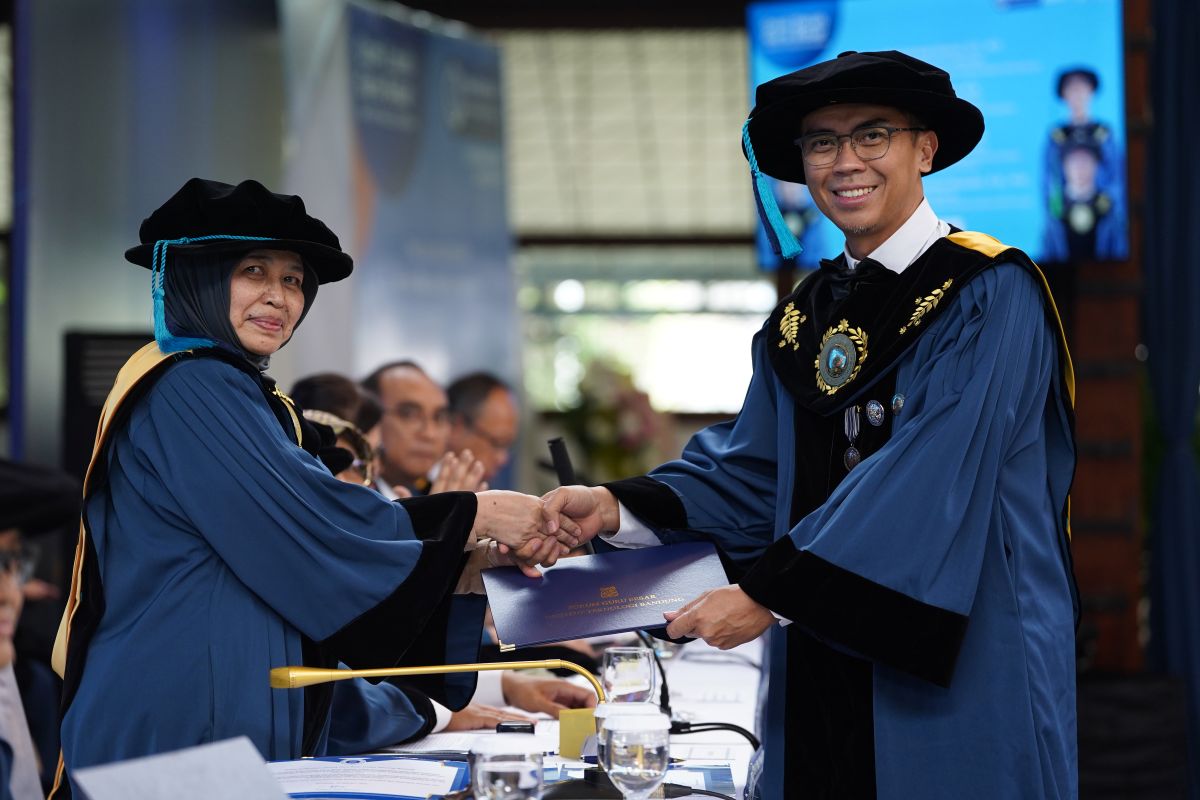
Collaboration among these stakeholders is essential to accelerating the transformation of research outcomes into technologies that can be widely implemented. Without a supportive ecosystem, innovations developed in laboratories may face numerous challenges before they can be integrated into healthcare services.
“Next-generation healthcare technology will not emerge from a single laboratory, a single discipline, or a single institution. We need an interconnected ecosystem,” said Prof. Sandro, highlighting the future direction of healthcare technology development.
Through his scientific oration, Prof. Sandro emphasized the significant potential of mechanics to contribute to healthcare technology development in Indonesia. However, this potential can only be realized when scientific and engineering excellence go hand in hand with user needs, rigorous validation, and collaboration across disciplines and institutions. Ultimately, the success of a technology is determined not only by its sophistication, but also by its ability to improve human quality of life.
.jpg)
.jpeg)
.jpg)

.jpg)