Exploring Stratigraphic Traps: SEG ITB Guest Lecture Unpacks Opportunities & Challenges in Oil and Gas Exploration
By Rafie Altaf Pramantya - Mahasiswa Teknik Geofisika, 2022
Editor M. Naufal Hafizh, S.S.
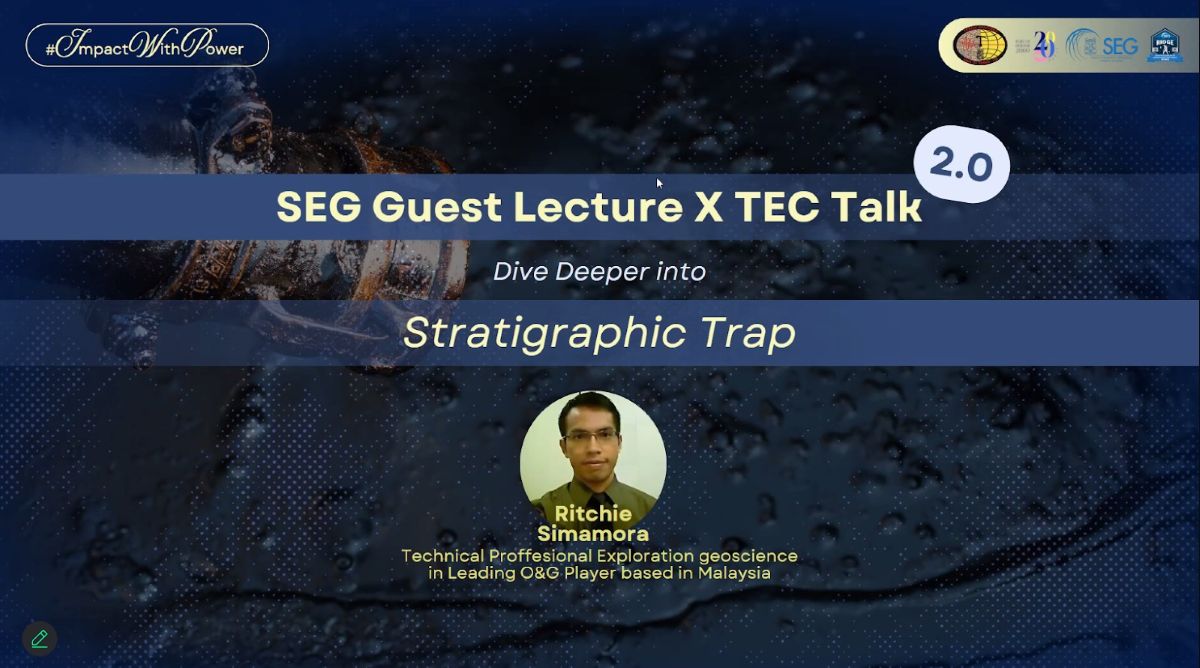
BANDUNG, itb.ac.id. The Society of Exploration Geophysicists Student Chapter at Institut Teknologi Bandung (ITB SEG SC) along with the Geophysical Engineering Student Association “TERRA” ITB (HIMA TG “TERRA” ITB) held "SEG Guest Lecture 2.0 x TEC Talk", Sunday (1/6/205). This event, which was open to all students, carried the theme "Dive Deeper into Stratigraphic Trap" and featured a Geoscientist from a leading oil and gas company in Malaysia, Ritchie Simamora.
This activity aimed to provide a deeper understanding of stratigraphic traps, a crucial concept in hydrocarbon exploration.
Ritchie Simamora introduced hydrocarbon traps, which are impermeable barriers that prevent further migration of hydrocarbons (oil and gas) and allow them to accumulate. These traps typically require porous reservoir rock and an overlying sealing rock (caprock).
He then explained two types of hydrocarbon traps: structural and stratigraphic.Structural traps are formed due to the deformation of rock layers such as folds and faults, examples being anticlines and fault traps. Meanwhile, stratigraphic traps are formed due to changes in rock properties like lithology, porosity, and permeability resulting from depositional or diagenetic processes, without requiring major deformation. Examples include pinch-outs, unconformities, and channel sands.
Ritchie stated that despite being difficult to find, stratigraphic traps hold immense potential for containing giant reserves, such as the Liza Field. Stratigraphic traps are often found in mature basins where structural traps have been previously discovered. This makes them a significantly underexplored potential. However, the challenge lies in their subtle nature, difficulty in prediction, and higher geological risk.
He also covered diagenetic traps which form or are significantly modified after deposition due to chemical or physical changes. An example is the destruction of porosity through cementation, where minerals precipitate in pore spaces, reducing permeability and forming a seal. Tar mats can also act as secondary seals.
Although stratigraphic traps are challenging to locate due to their subtle seismic expression and resolution issues, seismic data can provide important clues. Amplitude anomalies, seismic stratigraphy, and advanced attributes (coherence, spectral decomposition, inversion) are crucial for identification.
Ritchie Simamora emphasized that finding stratigraphic traps requires an integrated workflow and a comprehensive “geological toolkit”. This includes regional basin analysis and sequence stratigraphy, integration of high-resolution 3D seismic data, well logs, core data, biostratigraphy, and geochemistry.

He reminded participants that the role of a geologist in stratigraphic trap exploration is to be a “geological detective”. These traps are indeed challenging, but highly rewarding and represent significant future discoveries. Deep geological understanding, data integration, and readiness to face uncertainty are key. With advancements in AI/Machine Learning and higher-resolution seismic technologies, the ability to uncover these hidden traps will continue to improve.
Reporter: Rafie Altaf Pramantya (Geophysical Engineering, 2022)
Translator: Nadya Fini Nabila (Management, 2023)
.jpg)
.jpg)
.jpg)
.jpg)