Professor Acep Iwan Saidi’s Scientific Oration Highlights Ideology and Power Behind Classroom Design
By Indah Marcelinawati - Perencanaan Wilayah dan Kota, 2022
Editor Muhammad Efriza Pandia
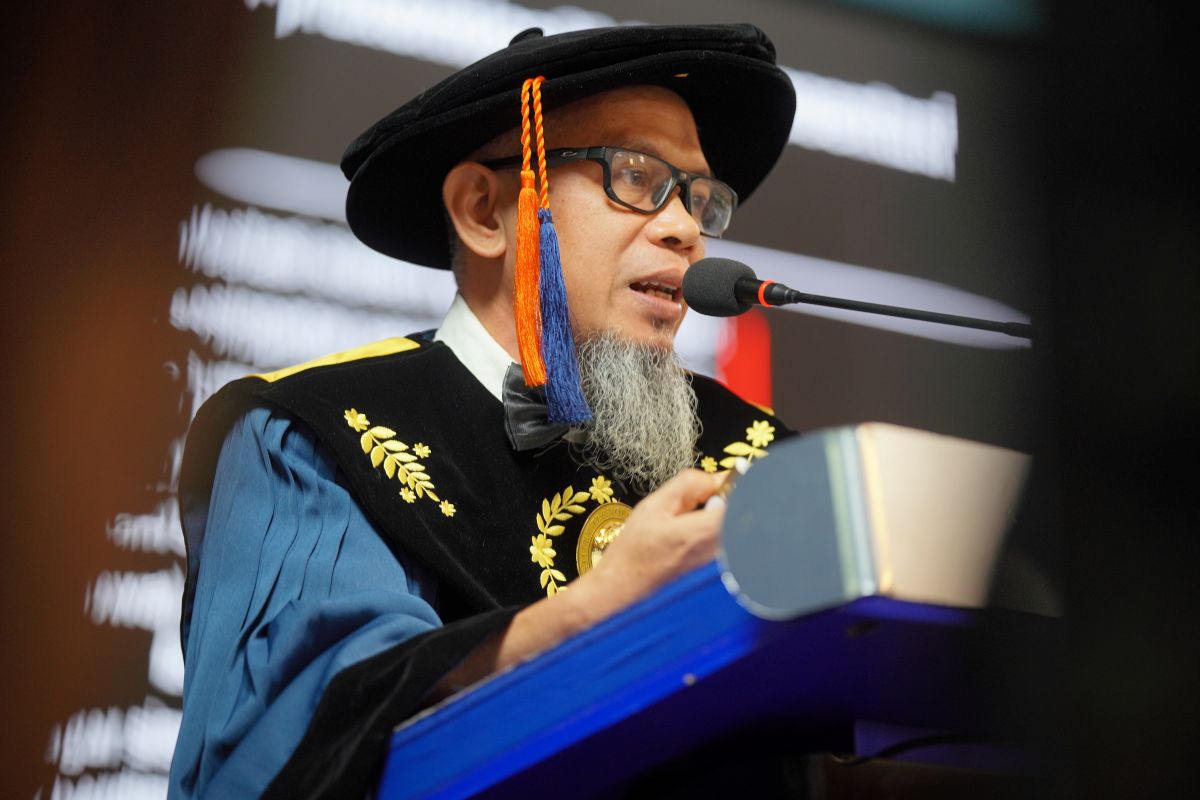
BANDUNG, itb.ac.id – The Institute of Technology Bandung's Forum of Professors (FGB ITB) held a scientific oration at Aula Barat, ITB Ganesha Campus, on Saturday (13/6/2026). In his oration entitled “Ideology and Power Behind the Design of Elementary and Secondary School Learning Spaces in Indonesia (A Semiotic Study),” Prof. Dr. Acep Iwan Saidi, S.Sn., M.Sn., explored how learning spaces function not only as venues for educational activities but also as mediums that represent ideology, social relations, and power practices that shape students’ learning experiences.
Prof. Acep Iwan Saidi explained that the study stemmed from a long-standing concern he had experienced since his years in elementary and secondary education. According to him, classroom designs encountered throughout his schooling were largely uniform and had changed very little over time. This condition prompted him to question why learning spaces were designed in such a similar manner and how these designs influence students’ educational experiences.
Through a semiotic perspective, Prof. Acep views space as a system of signs that carries particular meanings. The arrangement of space, the positioning of teachers and students, and the patterns of interaction formed within the classroom do not merely serve practical functions but also represent values, ideologies, and social relations operating behind them. Therefore, learning spaces cannot be understood as neutral entities, as every element within them contributes to shaping the way individuals think and interact.
"From a semiotic perspective, I see at least three relationships within this space. First, the relationship among fixed objects; second, the binary composition between teachers and students; and third, the relationship of equality among students," he stated.
In his presentation, Prof. Acep highlighted the conventional classroom design commonly found in Indonesia, characterized by rows of desks facing forward with the teacher positioned at the center of attention. According to him, this configuration creates a relationship that places teachers as the primary source of knowledge, while students are positioned as recipients of knowledge. Such a pattern indirectly establishes a hierarchical relationship between teachers and students and limits more egalitarian and participatory interactions.
Prof. Acep further explained that this learning space design is rooted in the paradigm of modernism, which emphasizes order, efficiency, and standardization. As a result, learning spaces tend to be designed uniformly without adequately considering the diverse social, cultural, and emotional needs of students. In fact, he argued that learning spaces play a significant role in shaping students’ character, creativity, and learning experiences.
"This spatial design is a product of modernity. Its ideological foundation is modernism, a perspective that views space as space, art as art, and science as science," he remarked.
Furthermore, Prof. Acep argued that classroom design can be understood as a representation of ideology and power operating subtly within the education system. Learning spaces become mediums that regulate interaction patterns, discipline, and relationships among individuals. Consequently, spatial design not only influences the learning process but also shapes students’ perspectives on authority, knowledge, and their social environment.
"Students are brought together in one room, yet once inside they are separated by rules. They are not allowed to look left or right, to cheat, or even to read aloud," he explained.
In closing, Prof. Acep emphasized that learning space design should become an important consideration in the formulation of educational policies. According to him, learning environments that provide students with freedom, a sense of ownership, and emotional attachment will better support the development of creative, critical, and well-rounded individuals. He also encouraged future learning space designs to be based on research into students’ needs while taking into account the diverse social and cultural contexts of Indonesian society.
Reporter: Indah Marcelinawati (Urban and Regional Planning, 2022)
.png)
.jpg)
.jpg)
.jpg)
.jpg)