Shana Fatina, ITB Alumna Making an Impact by Empowering Villages into World-Class Destinations
By Vito Egi Nandriansyah - Teknik Geofisika, 2021
Editor M. Naufal Hafizh, S.S.
.jpg)
BANDUNG, itb.ac.id – For Shana Fatina, development in Indonesia’s frontier, outermost, and disadvantaged regions (3T) does not begin with grand dreams of tourism destinations, but with the most basic needs that determine people’s quality of life. Through efforts to provide access to clean water in Labuan Bajo, the Founder and CEO of Komodo Water, who is also a 2004 alumna of Industrial Engineering at ITB, has shown that addressing fundamental issues can become an entry point for broader social, economic, and tourism transformation in a more sustainable way.
She shared this idea during an ITB Studium Generale titled “From Village to World-Class Destination: Community Empowerment in the Tourism Ecosystem” at Aula Barat, ITB Ganesha Campus, on Wednesday (1/4/2026).
Shana, who served as President Director of the Labuan Bajo Flores Tourism Authority from 2019 to 2024, explained that in Labuan Bajo—widely known as the gateway to Komodo National Park and a world-class tourism destination—some residents still have to travel up to six hours just to obtain clean water. In fact, more than 25 percent of their monthly income may be spent solely on purchasing water.
According to Shana, water is not merely a household necessity. When access to clean water becomes easier, communities gain more time and new economic opportunities, ranging from fisheries to agriculture.
“When access to water becomes easier, people have more time for economic activities. Fishermen can now produce their own ice without having to go to Labuan Bajo, and agricultural sectors such as coffee farming in Flores can also develop more optimally,” she said.
Development Must Be Seen as an Ecosystem
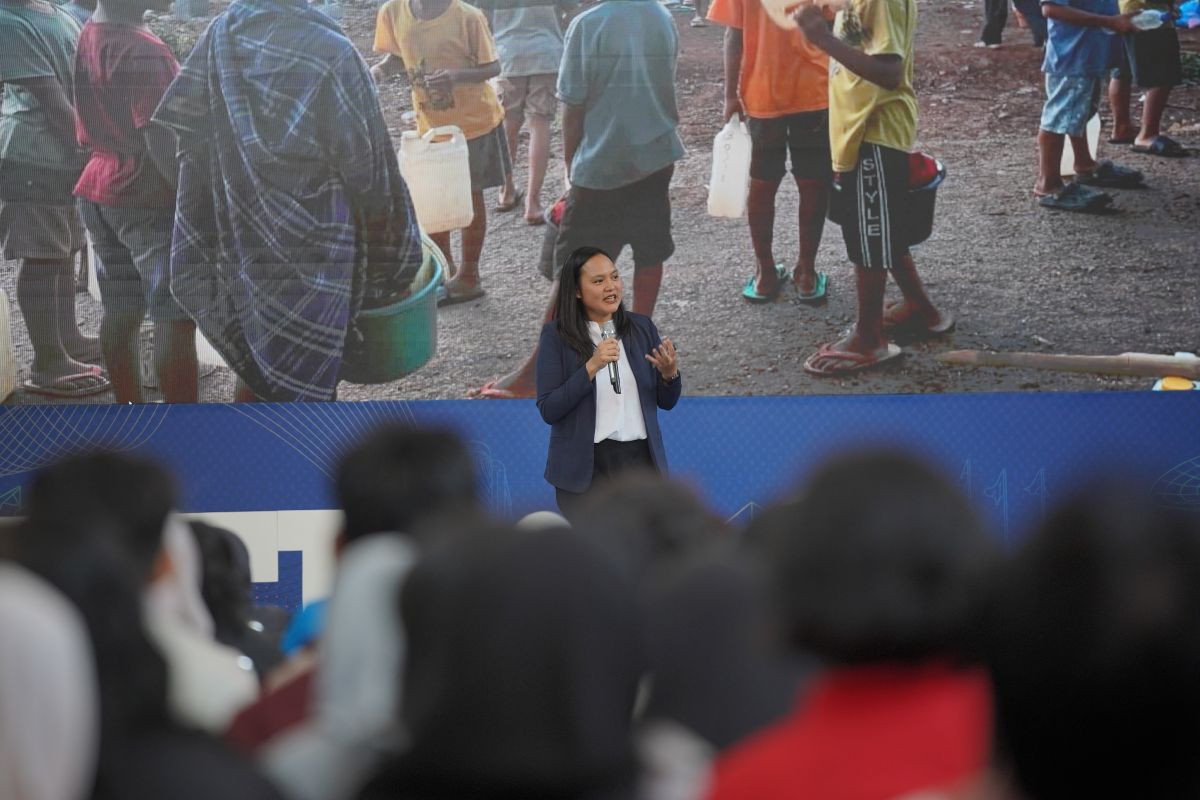
Shana emphasized that development in 3T regions cannot be viewed partially. It must be understood as an interconnected ecosystem.
“Water is not only a basic necessity, but also a foundation for culture, economy, and tourism—water for culture, water for economy, and water for tourism,” she stated.
She encouraged students to recognize the paradigm shift in tourism development. Whereas many destinations were once built around the idea of sea, sun, and sand, the approach now needs to move toward spirituality, serenity, and sustainability. For her, strong tourism is not only about natural beauty, but also about building a more dignified and sustainable life for local communities.
She also noted that life in urban areas comes with many privileges—not only in terms of material resources, but also access to education, knowledge, networks, information, and various opportunities. Awareness of this is important so that young people do not come to villages with the assumption that they know best, but instead become more sensitive, willing to learn, and able to understand the real needs of the community.
In addition, she believes that becoming a social entrepreneur requires the courage to truly be present among the people and experience village life firsthand. There is a long process of understanding the social and cultural context, as well as the way people live. Such an approach is essential so that solutions genuinely emerge from the community’s actual needs.
Lessons from Organizational Life at ITB
.jpg)
In addition to sharing her professional experience, Shana also reflected on her years at ITB as an important foundation for building networks and social awareness. As a student, she was actively involved in the Industrial Engineering Student Association (MTI) ITB, the ITB Student Executive Cabinet (KM ITB), and various student activity units, including Apres! ITB, LFM ITB, and the ITB Student Orchestra.
According to her, campus life gave her the opportunity to meet many people from different backgrounds while also learning to collaborate across disciplines.
“At ITB, we are brought together with people who share similar interests, but we are also encouraged to think beyond our own majors and move together with our respective missions,” she said.
She also shared a simple principle that she still remembers to this day.
“I still remember hearing that at ITB, you should have 10,000 friends. Getting to know as many people as possible from different majors opens up many perspectives and opportunities for collaboration,” she said.
Big Impact Begins with Small Steps
Shana said that major change does not always begin with something spectacular. Impact can grow from simple acts of care for the surrounding environment.
“Caring is a sign of our humanity. It does not have to create a huge impact right away, but it starts from around us. From a small step, from 0 to 1, it can lead to a different ending,” she said.
.jpg)
.jpg)
.jpeg)
.jpg)
.jpeg)