Alumni of ITB Engineering Physics on the Challenges and Prospects of the Automotive Industry
By Adi Permana
Editor Adi Permana

BANDUNG, itb.ac.id – The Engineering Physics Vocational Association of Indonesia Institution of Engineers held a sharing session on Wednesday (9/3/2022), discussing the performance, obstacles, and opportunities of ICE and electrical automotive industries in the country. The speaker for this panel was the Director of Suzuki Indomobil Motor and Head of V GAKINDO, Shodiq Wicaksono.
Shodiq, an alumnus of ITB majoring in engineering physics, explained the trends of using electrical semiconductors on motorized vehicles, especially cars. “The use of semiconductors from the 1960s keeps on growing. The latest data in 2010 shows that 35% of car components are electrical components that make up its active-passive safety, telematics, and advanced driver assistance.” It was also mentioned that 80% of current electronic inventions are unable to comply with regulations without electrical systems.
Since the beginning of Ford's mass-production of four-wheeled vehicles with T models in 1908, there has been a fundamental shift from the usage of mechanical vehicles to electric ones, resulting in more units being installed with microchips, rising electrification of automobiles, and its significant impact on the vehicle supply chain.
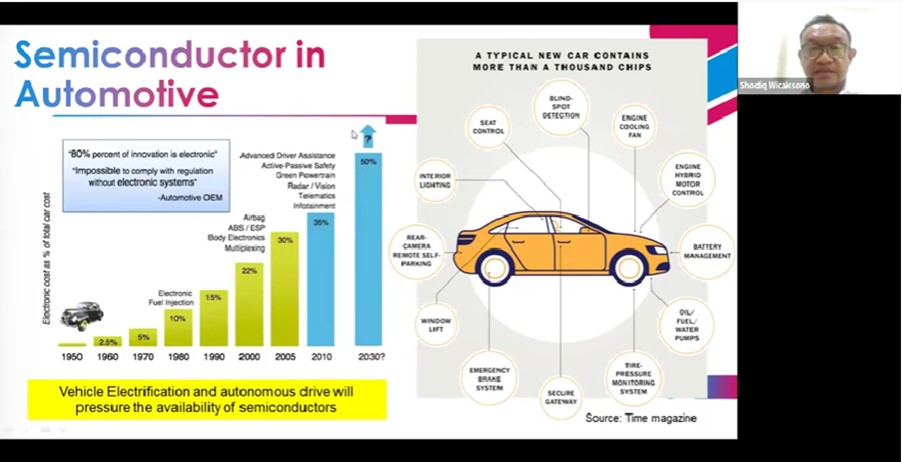
The latest car types can contain more than a thousand microchips. Their performance is determined by their newest features such as their interior lighting, seat control, engine cooling fan, battery management, emergency brake system, window light, rear camera for remote self-parking, blind-spot detection, and secure gateway.
This shift inadvertently creates threats that may stop the production of certain components and disrupts the industry's sustainability. Electrification can affect the environment; however, its effects vary for each country due to the difference in their energy source profile. Thus, this transition needs to be handled wisely with capable and well-prepared human resources to ensure its synergy.
To face the shift, strategies and targets are set up to enhance Indonesia's automotive industry. “The target is to run an automotive industry that can compete in the market. Meanwhile, the strategy is to optimize the industry's production capacity that has never been utilized for domestic markets and exportation needs,” Shodiq explained. Because of the tough competition in both national and global markets, regulations are necessary to boost competitiveness.
In developing the national automotive industry, the government applies sales tax subsidies on luxury goods, especially motorized vehicles. “This is done not only to support the economic growth but also to save the industry’s ecosystem that consists of more than 1000 corporations and 1.5 million employees,” Shodiq stated.
The government ensures environmental sustainability by devising policies for four-wheeled vehicles with low carbon emissions. These LCEVs (Low Carbon Emission Vehicles) contribute to a more energy-efficient and environmentally friendly LCGCs (Low-Cost Green Car). In the future, many automotive producers in Indonesia–primarily those specializing in cars–can develop other types of electric-powered cars like HEV, PHEV, and BEV. Through these policies, the automotive producers can also start researching biofuel utilization.
Nonetheless, there are still obstacles along the journey. For instance, the price of electric vehicles, their market entrance in Indonesia, and the infrastructures to charge them are lacking. Hence, Indonesia must start preparing and predicting the changes in trends to allow a smooth transition into a thriving automotive industry.
Reporter: Yoel Enrico Meiliano (Food Engineering, 2020)
Translator: Ruth Nathania (Environmental Engineering, 2019)
.jpg)
.jpeg)
.jpg)
.jpg)
.jpeg)