Exploring Rare Earth Elements, ITB Geological Engineering Students Win First Place in Mineral Clash
By Indah Marcelinawati - Mahasiswa Perencanaan Wilayah dan Kota, 2022
Editor Muhammad Efriza Pandia
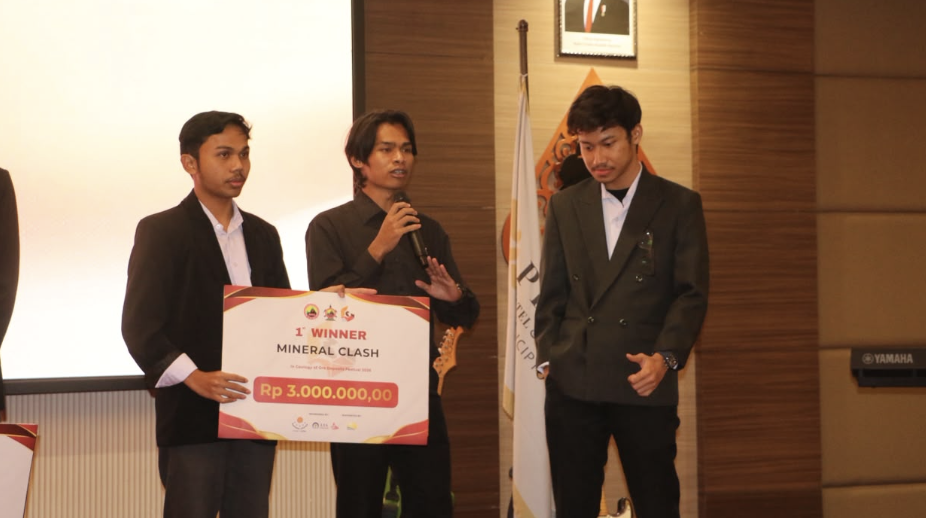
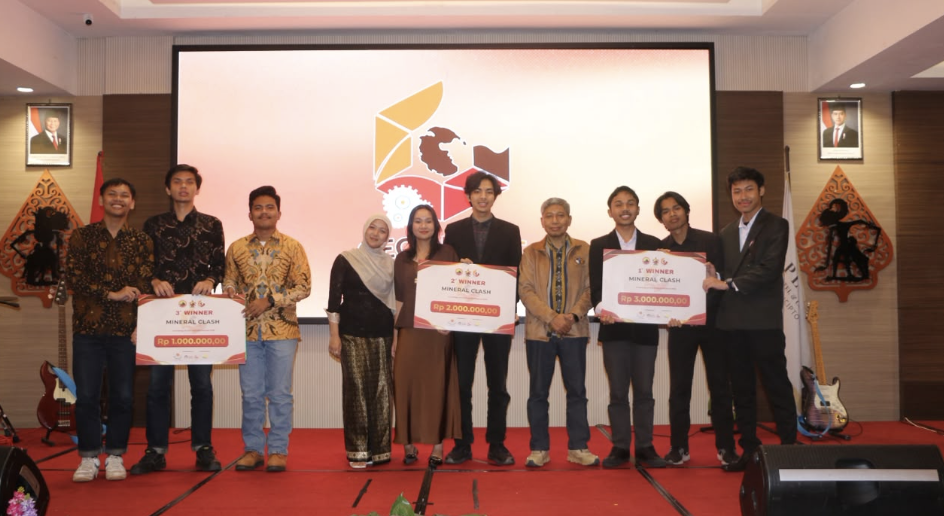
Caption: ITB Geological Engineering students won first place in the Mineral Clash competition at GEODEFEST 2026 in Yogyakarta on Saturday (June 6, 2026). (Courtesy of the GEODEFEST 2026 Committee)
YOGYAKARTA, itb.ac.id — A team of students from the Geological Engineering Study Program at Institut Teknologi Bandung (ITB) won first place in the Mineral Clash competition, part of GEODEFEST 2026 organized by the MGEI Student Chapter of UPN “Veteran” Yogyakarta.
The achievement was earned by Team “Duaduanya,” comprising Saifurrohman Ar Robbani (2023), Kelvin Andika Putra (2022), and Rafi Shafwan Subiyanto (2022).
Mineral Clash is an academic competition focusing on economic geology and mineral resource exploration, particularly Rare Earth Elements (REE). The competition challenged students from earth science disciplines at universities across Indonesia to demonstrate their conceptual understanding, analytical skills, and teamwork through several stages of competition.
For Team “Duaduanya,” their interest in participating in the competition stemmed from the REE theme, which they considered highly relevant to developments in geological science and current issues surrounding mineral resource exploration. The quiz-based competition format also provided an opportunity for the team to deepen their understanding of the subject in a more focused manner.
Driven by an Interest in Rare Earth Elements
Saifurrohman said that the REE theme was one of the main reasons the team decided to participate in Mineral Clash. According to him, the topic is closely related to current developments and challenges in mineral resource exploration.
“We found the Rare Earth Elements theme particularly interesting because it is closely related to issues that are currently widely discussed in the field of geology. Through this competition, we wanted to learn more about the topic,” he said.
The team prepared for the competition gradually by adapting their approach to each stage. During the preliminary round, each member studied the syllabus independently before holding brief discussions ahead of the competition. As they advanced to the semifinal round, the team allocated more time for discussion to further strengthen their understanding of the material.
A more focused strategy was implemented during the final round. The team divided the entire syllabus into specific topics, allowing each member to concentrate on a particular area of study.
Saifurrohman focused on REE associated with coal, the Mamuju region, and carbonatite deposits. Meanwhile, Rafi Shafwan Subiyanto studied REE in laterite and placer deposits, as well as occurrences in South Sulawesi and Kalimantan. Kelvin Andika Putra concentrated on hydrothermal systems, syenite-associated deposits, and the Sumatra region.
This division of responsibilities enabled each team member to develop a deeper understanding of their respective areas while allowing the team to master the overall material through collaboration.
“We did not try to memorize all the material. Each of us focused on developing an in-depth understanding of our respective fields and trusted one another during the competition. This approach allowed us to cover almost the entire syllabus,” Saifurrohman explained.
Balancing Competition Preparation and Academic Responsibilities
Preparing for the competition presented another challenge for Team “Duaduanya,” particularly in balancing their preparation with academic responsibilities. As students from different academic cohorts, each team member had different schedules and commitments.
The two members from the 2022 cohort were completing their final projects and preparing for their colloquiums. Meanwhile, the member from the 2023 cohort was preparing for and taking final examinations.
Their differing schedules even prevented the three members from traveling to the final competition venue together. Nevertheless, effective communication and time management enabled them to maintain a consistent preparation process.
For the team, productive discussions did not necessarily have to take place over long periods. As long as each member consistently made time to study the material and exchange ideas, they believed that preparation could remain effective.
Beyond expanding their knowledge of REE and economic geology, the competition also provided valuable lessons for the three students in building effective teamwork.
“The most valuable lesson we learned was the importance of collaboration and mutual trust. In a team, each member has expertise in different topics, such as coal, nickel laterite, and epithermal deposits. We learned that success does not come from everyone mastering every subject, but from a team’s ability to complement one another, trust each other’s expertise, and work together effectively,” Saifurrohman said.
For Team “Duaduanya,” trust became an essential foundation throughout the competition. With a clear division of focus, each member was able to develop expertise in their assigned area while relying on the competencies of their teammates.
Winning first place in the Mineral Clash competition at GEODEFEST 2026 ultimately became an experience that not only enriched the team’s academic understanding of mineral resources but also strengthened their ability to collaborate and build trust as a team.
.jpeg)
.jpg)
.jpg)
.jpg)
.jpg)
.jpg)

