Prof. Gatot Yudoko’s Scientific Oration Highlights the Role of Sustainable Operations Strategy in Strengthening the Competitiveness of Indonesian Organizations
By Merryta Kusumawati - Teknik Geodesi dan Geomatika, 2021
Editor Muhammad Efriza Pandia
.jpg)
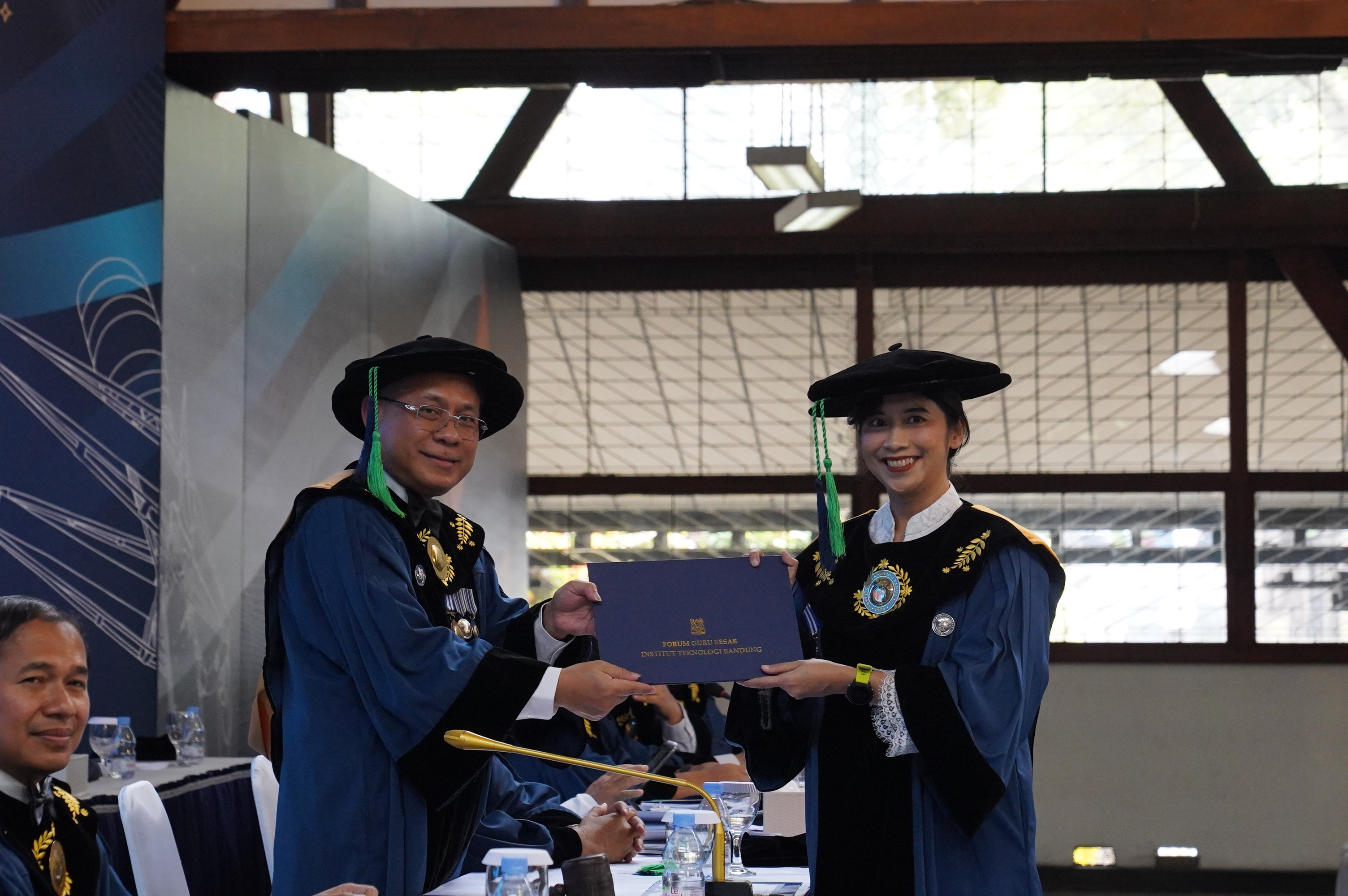
BANDUNG, itb.ac.id - The Forum of Professors of Institut Teknologi Bandung (FGB ITB) held a Professor’s Scientific Oration Session at Aula Barat ITB on Saturday (13/6/2026). On this occasion, Prof. Ir. Gatot Yudoko, M.A.Sc., Ph.D., from the School of Business and Management, Institut Teknologi Bandung (SBM ITB), delivered a scientific oration entitled “The Role of Sustainable Operations Strategy in Supporting the Competitiveness of Indonesian Organizations.”
Prof. Gatot emphasized that operations strategy does not only focus on production efficiency. It also plays an important role in building competitiveness, encouraging organizational adaptation, and integrating sustainability principles into management practices.
“This is a reflection of the accumulation of my tridharma activities at ITB,” he said.
According to him, operations strategy, which initially developed largely in the context of manufacturing industries in advanced countries, is now relevant to be applied in Indonesia, ranging from large companies, small industries, micro-enterprises, to nonprofit organizations.
Operations Strategy as the Foundation of Competitiveness
According to Prof. Gatot, operations strategy consists of two main types of decisions: structural decisions and system-based decisions. Structural decisions include capacity, facilities, location, process technology, and supply chains, while system-based decisions cover human resources, quality, product or service development, performance, operational planning, and organization.
He explained that operations strategy works through both top-down and bottom-up processes. Corporate strategy serves as a reference for business and operations strategies, while daily operational implementation provides feedback on organizational performance and strategic direction. Therefore, operations strategy plays a vital role in improving efficiency, productivity, competitiveness, and organizational adaptability.
.jpg)
The relevance of operations strategy becomes even more apparent in the context of Indonesian MSMEs. Based on the MSME distribution figure, Indonesia had 30,209,069 business units as of December 31, 2025, with the largest concentration located on Java Island, totaling 17,551,821 business units, followed by Sumatra, Sulawesi, Bali and Nusa Tenggara, Kalimantan, as well as Maluku and Papua. This distribution shows that operations strategy is important for MSMEs because each region has different capacities, characteristics, and operational challenges.
“Operations also contribute to the creation and development of competitiveness, for example through cost strategy, differentiation, focus, or value innovation,” he explained.
Sustainability in Operations Strategy
.jpg)
Furthermore, Prof. Gatot stressed that sustainability principles need to be integrated into operations strategy, rather than stopping merely at the level of global commitment. According to him, the Sustainable Development Goals (SDGs) agenda must be translated into corporate strategy, business strategy, and operations strategy so that it can have a direct impact on organizational practices.
“I propose six propositions that form the conceptual framework of sustainable operations strategy,” he stated.
The framework includes global commitment, sustainable corporate and business strategies, the dynamics of top-down and bottom-up processes, structural decisions in operational systems, and their impact on resources, business processes, and organizational performance. Thus, sustainable operations strategy does not only pursue efficiency, but also encourages organizations to contribute to social, economic, and environmental aspects.
From Diverse Organizations toward Sustainable Transformation
To strengthen his theoretical framework, Prof. Gatot used a multiple-case study approach involving various organizations, ranging from large companies, industrial estates, mining companies, special economic zones, small industries, informal micro-enterprises, to nonprofit organizations. He also included cases rarely discussed in Western operations strategy literature, such as the Cibaduyut footwear industrial center, electronic waste recycling businesses in Bogor, food banks in several major cities, and the Banyuwangi Living Lab in a plastic waste management project.
“These are business units that may rarely, or perhaps never, be discussed in Western literature,” he said.
The results of his study show that the six propositions of sustainable operations strategy can be confirmed, although their implementation differs according to organizational scale and type. These findings affirm that sustainable operations strategy is relevant in supporting Indonesia’s transformation agenda, including digitalization, certification, partnerships, environmental management, circular economy, net zero emission, and readiness to face global policies such as the Carbon Border Adjustment Mechanism.
Prof. Gatot also emphasized the importance of supporting MSMEs, particularly in halal certification and business process digitalization.
“Sustainable operations strategy contributes to the development of competitiveness and the achievement of the Sustainable Development Goals,” he said. Therefore, sustainability can serve as the foundation for developing operations strategies that are more adaptive, competitive, and relevant to future challenges.
Profile of Prof. Ir. Gatot Yudoko
Prof. Ir. Gatot Yudoko, M.A.Sc., Ph.D., was born in Semarang on July 25, 1961. He is an ITB Professor in the field of operations strategy, with expertise in Operations and Performance Management. He completed his elementary to secondary education in Boyolali, earned his Bachelor’s degree in Industrial Engineering from ITB in 1985, and obtained his Master’s degree in Transportation from ITB in 1990. He later continued his studies at the University of Waterloo, Canada, where he earned a Master of Applied Science in 1993 and a Doctor of Philosophy in 2000.
Prof. Gatot began his academic career as a lecturer at the Department of Industrial Engineering ITB from 1987 to 2005, before joining SBM ITB. Throughout his career at ITB, he has served as Secretary of the Department of Industrial Engineering ITB, Head of the Master of Science in Management Program ITB, Vice Dean for Academic Affairs at SBM ITB, Head of the Operations and Performance Management Expertise Group at SBM ITB, and Chair of the SBM ITB Senate for the 2018-2023 period.
In research, Prof. Gatot has actively developed studies related to operations strategy, operations and supply chain management, green logistics, halal logistics, circular economy, MSME capacity building, plastic waste management, and organizational competitiveness. He is also active in producing scientific publications in international journals, book chapters, and various community service activities involving industries, state-owned enterprises, ministries, government institutions, and regional governments.
For his contributions, Prof. Gatot has received several awards, including the 10-Year Satyalancana Karya Satya from the President of the Republic of Indonesia in 2003, the 20-Year Satyalancana Karya Satya in 2007, the ITB Award in Research in 2017, the 30-Year Satyalancana Karya Satya in 2018, the ITB Award in Teaching in 2018, and the ITB 35-Year Service Award Certificate in 2022.
Reporter: Merryta Kusumawati (Geodesy and Geomatics Engineering, 2021)
.png)
.jpg)
.jpg)
.jpg)
.jpg)


.jpg)