Three ITB Students Develop AI Solutions for Waste Sorting, Food Transportation, and Worker Safety
By Jekky - Mahasiswa Teknik Pertambangan, 2023
Editor M. Naufal Hafizh, S.S.
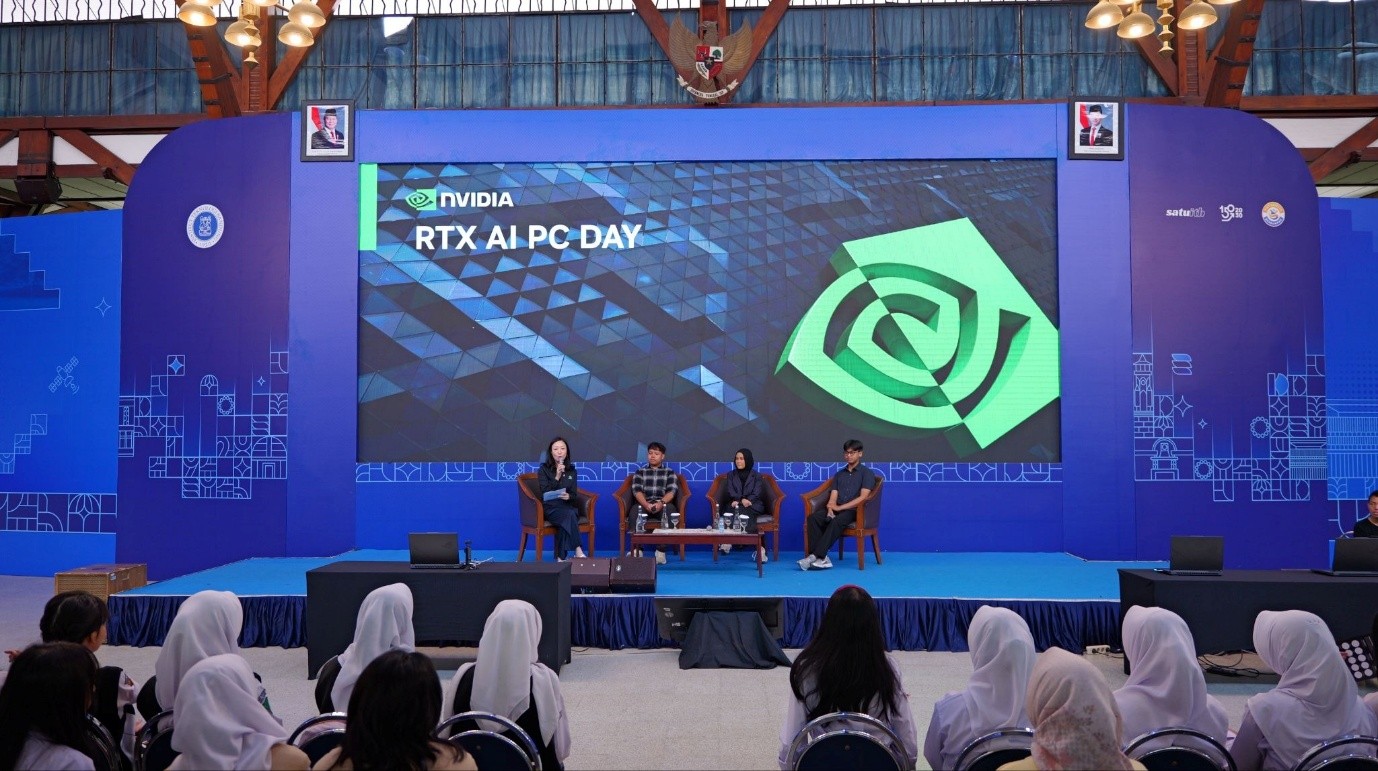
Petty Kusnandar (NVIDIA Indonesia) moderates a discussion featuring Muhammad Taufiq Al Fikri, Tsabita Khoirunnisa, and Izhar Alif Akbar during the Panel Discussion with Student Ambassador session at NVIDIA RTX AI PC Day 2, held at the East Hall of ITB Ganesha Campus on Tuesday (October 20, 2026). (Photo: NVIDIA Event Organizing Committee)
BANDUNG, itb.ac.id — Three students from Institut Teknologi Bandung (ITB) have developed and demonstrated artificial intelligence (AI) technologies designed to address three challenges: contamination in paper waste that complicates recycling, the risk of food spoilage during temperature-controlled transportation, and the monitoring of workplace postures that may pose health risks to factory workers. These innovations have the potential to help waste management operators, recycling industries, food distribution companies, and occupational health and safety (OHS) personnel make faster and more informed decisions.
The three innovations are RecycledFiberAI, developed by Muhammad Taufiq Al Fikri (Master's Program in Artificial Intelligence); ColdTrack AI, developed by Tsabita Khoirunnisa; and REBA.ai, developed by Izhar Alif Akbar. Both Tsabita and Izhar are students in the Information Systems and Technology Program.
During the demonstrations, the students showcased how AI can detect contaminants in paper waste in real time, predict when cargo temperatures are likely to exceed safe limits, and assess workers' postures through cameras. These technologies offer opportunities to reduce resource waste, prevent economic losses, and promote safer working environments.
Local AI Solutions for Real-World Challenges
The three students presented their innovations during the Panel Discussion with Student Ambassador session at NVIDIA RTX AI PC Day 2, jointly organized by NVIDIA and ITB at the East Hall of ITB Ganesha Campus on Tuesday (October 20, 2026).
All three AI systems operated locally without relying on cloud computing. The demonstrations were conducted using three ASUS ROG Strix G16 laptops equipped with NVIDIA GeForce RTX 5070 GPUs, which were provided on loan to the students.
Sorting Paper Waste in Real Time
Taufiq began his presentation by highlighting a familiar everyday problem: waste being disposed of incorrectly. He focused on paper waste, which, together with cardboard, accounts for approximately 11.4 percent of Indonesia's total waste. Paper recycling factories require clean paper waste as raw material. However, contamination in locally sourced paper waste has led some factories to rely on imports.
To address this challenge, Taufiq developed RecycledFiberAI, a computer vision-based AI system capable of detecting contaminants in paper waste in real time through a camera.
The system operates through four stages: a camera captures video footage, an AI model identifies four types of contaminants, an object-tracking system counts detected items without duplication, and a live dashboard displays the results.
"Policies in industry and government may differ, but the implementation remains the same: the AI model and dashboard are connected to the operator's camera feed," Taufiq explained.
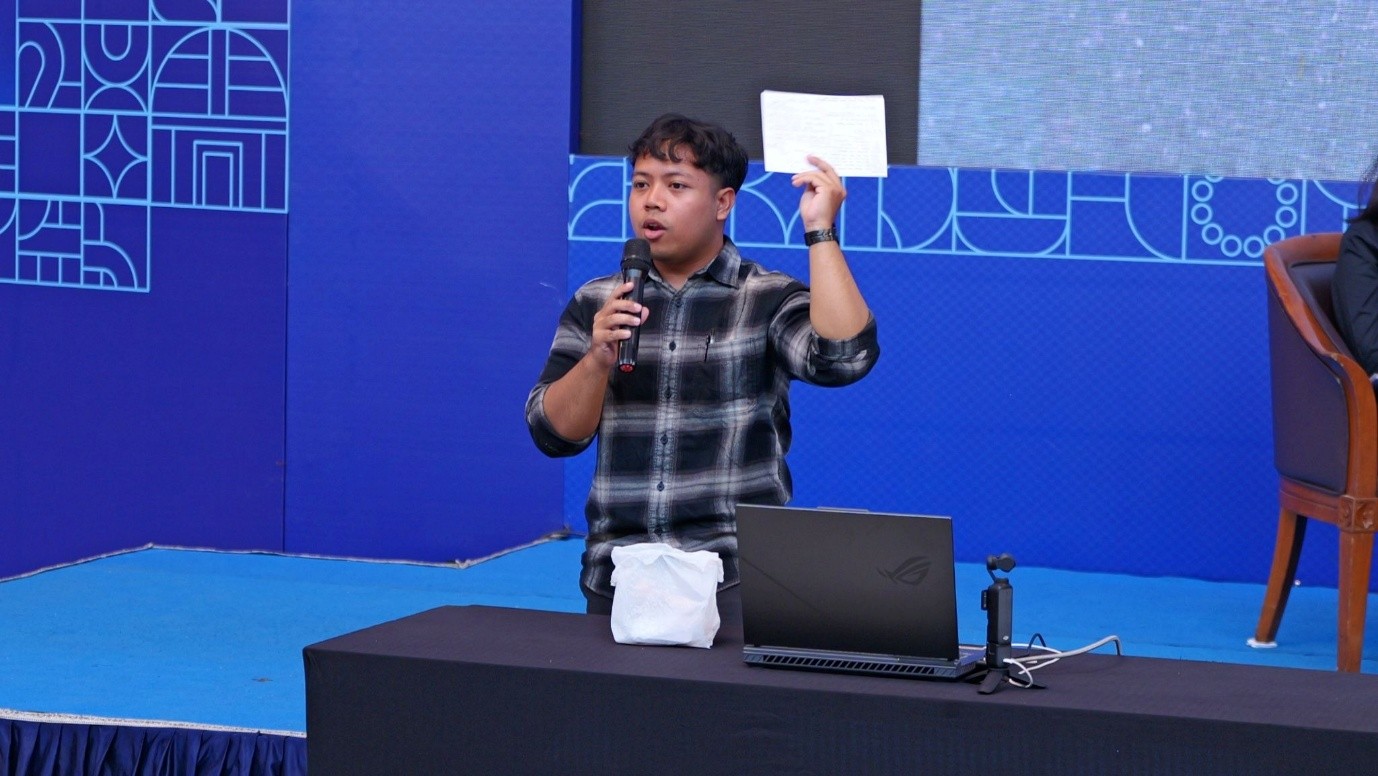
Muhammad Taufiq Al Fikri holds up a sheet of paper and a plastic bag during a live demonstration of RecycledFiberAI, which runs locally on a laptop, at NVIDIA RTX AI PC Day 2 at the East Hall of ITB Ganesha Campus on Tuesday (October 20, 2026). (Photo: NVIDIA Event Organizing Committee)
The system has potential applications in two sectors: industry, particularly paper recycling factories, and government-operated waste management facilities, including integrated waste processing facilities (TPST) and reduce, reuse, recycle waste processing facilities (TPS3R).
During the live demonstration, the dashboard displayed real-time detection results from the camera. Clean paper waste was left unmarked, while contaminants such as plastic were identified as materials that needed to be removed.
"For a system to be considered real-time, it must process a single image in approximately 33 milliseconds. A high-end laptop CPU can only achieve 8.9 frames per second, while the RTX 5070 can reach 66.1 frames per second, making it approximately 7.4 times faster," Taufiq explained.
Preventing Cold Chain Failures Before They Occur
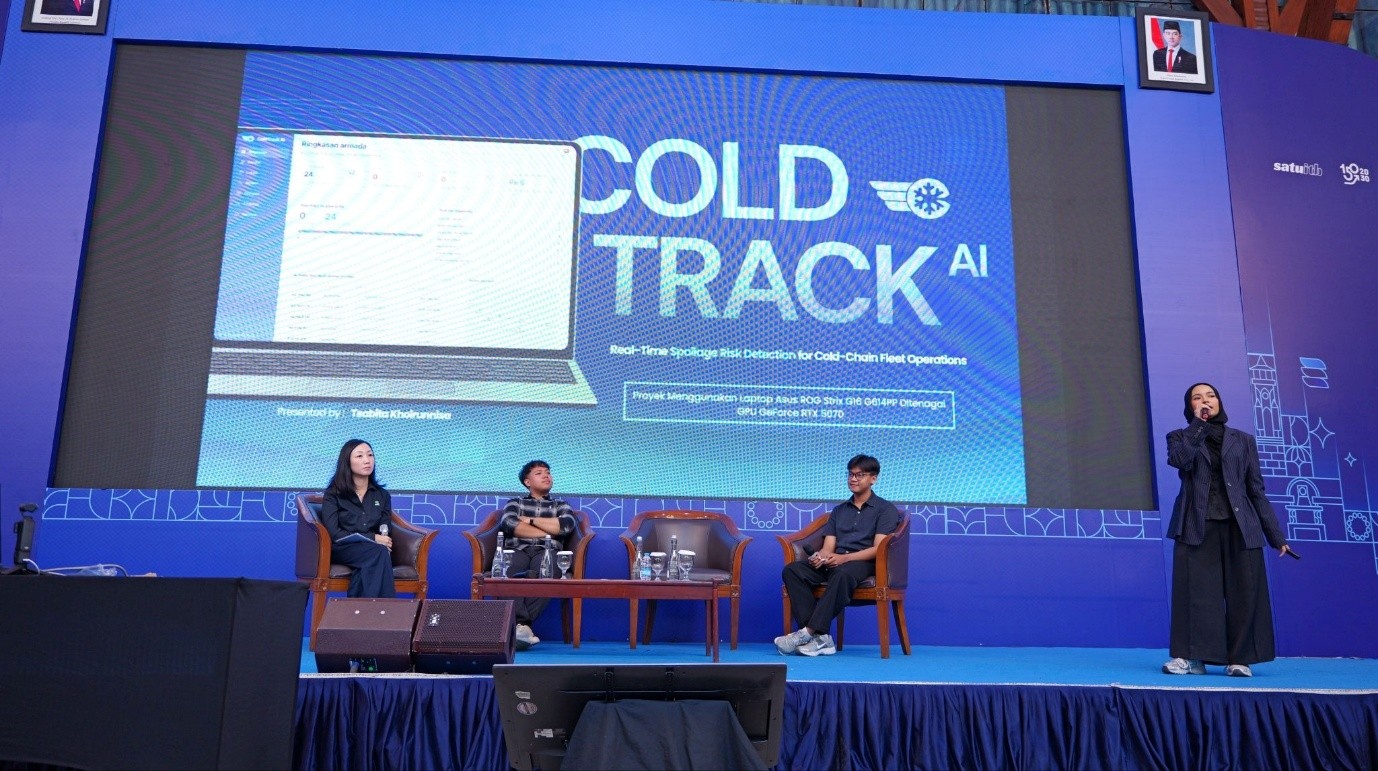
Tsabita Khoirunnisa presents ColdTrack AI, an AI-based system designed to monitor the risk of cargo spoilage in cold chain logistics, during NVIDIA RTX AI PC Day 2 at the East Hall of ITB Ganesha Campus on Tuesday (October 20, 2026). (Photo: NVIDIA Event Organizing Committee)
Meanwhile, Tsabita highlighted the challenges of transporting temperature-sensitive products, such as fish and milk. She illustrated the problem through a hypothetical example involving Mr. Adi, a fleet operator at a frozen food distribution company who discovers that his cargo has spoiled only after the truck arrives at the warehouse.
"The sensors are actually already installed and continuously monitor temperatures throughout the journey. However, the damage is only discovered when the goods arrive, when it is already too late and the losses have increased," Tsabita explained.
She connected this problem to data indicating that approximately 23–48 million tons of food are wasted in Indonesia annually, with some of these losses associated with cold chain failures.
To address this issue, Tsabita developed ColdTrack AI, an AI-powered system that monitors sensor data, predicts when temperatures will exceed acceptable limits, and provides explanations and recommended actions to operators through a dashboard.
During the demonstration, the dashboard displayed the status of each vehicle (safe, warning, or critical), its location, sensor conditions, estimated economic risk, and recommended tasks for operators.
In one simulated scenario, a truck door was left open, causing the cargo temperature to rise.
"The system calculated that there were approximately 21 minutes before the temperature exceeded the safe limit, giving operators time to take action before the goods were damaged," she explained.
Tsabita also emphasized that the improved processing speed did not compromise the system's accuracy.
"This speed does not come at the expense of quality, as all 26 model parity tests were successfully passed on both devices," she said.
Monitoring Factory Workers' Postures Using CCTV
Izhar, meanwhile, addressed the risks faced by factory workers who repeatedly perform tasks in the same non-ergonomic positions. Such working conditions can contribute to musculoskeletal disorders, particularly lower back problems.
"The assessment method already exists through the REBA standard, which has been established since 2000. The problem is not the assessment method itself, but the fact that it is still carried out manually," Izhar explained.
REBA (Rapid Entire Body Assessment) is a method used to evaluate risks associated with working postures. Assessing hundreds of workers individually is time-consuming. As a result, occupational health and safety (OHS) personnel may only be able to assess approximately five out of every 100 workers in a single day.
To overcome this limitation, Izhar developed REBA.ai, an AI system that analyzes workers' postures using CCTV footage and identifies both appropriate and potentially harmful positions.
In a factory setting, the system could monitor hundreds of workers simultaneously using existing surveillance cameras.
Its development involves two main stages: training the AI model and running it. To train the model, Izhar created and labeled examples of both correct and incorrect working postures, enabling the AI to distinguish between them.
"That is where the challenge lies, because AI can only learn when we provide examples of what is right and what is wrong," he explained.
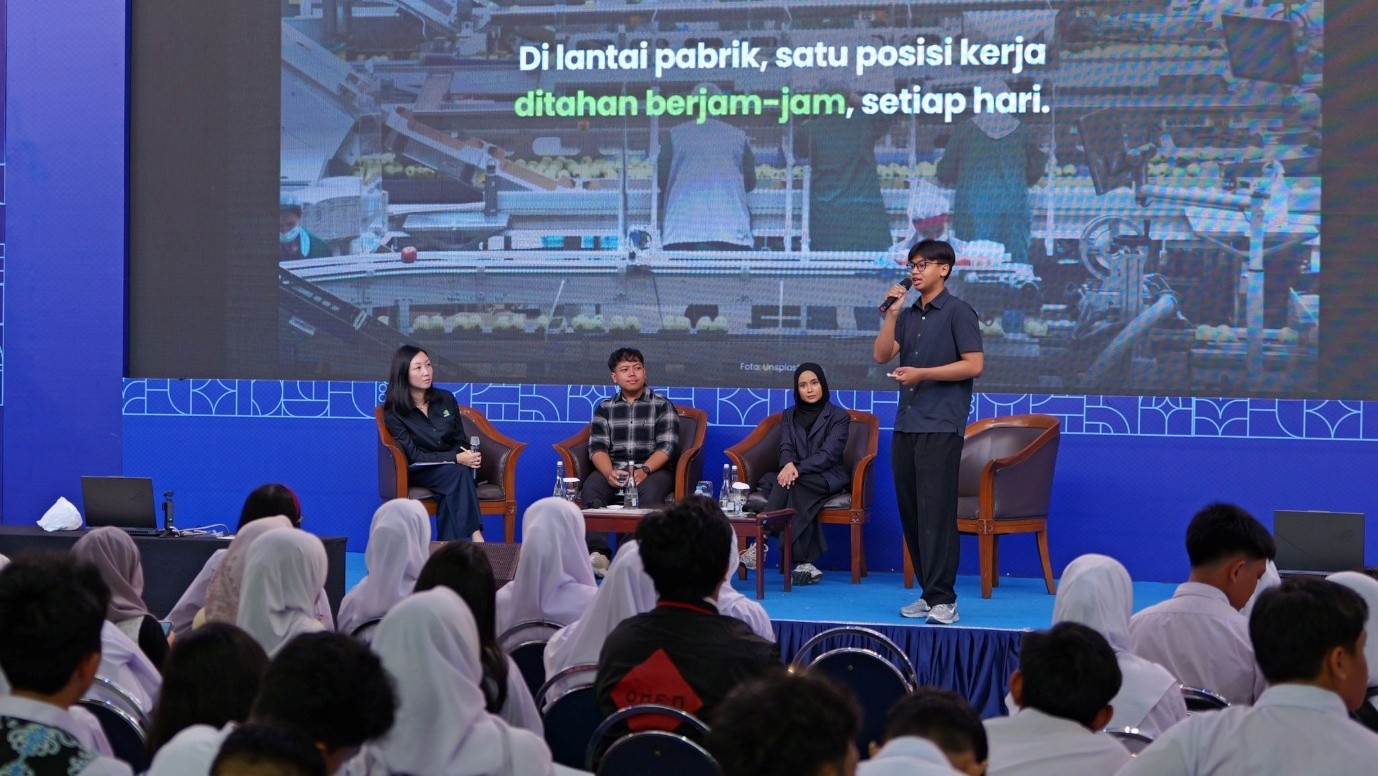
Izhar Alif Akbar presents REBA.ai, an AI-based system designed to monitor factory workers' postures using CCTV cameras, during NVIDIA RTX AI PC Day 2 at the East Hall of ITB Ganesha Campus on Tuesday (October 20, 2026). (Photo: NVIDIA Event Organizing Committee)
During the live demonstration, Izhar invited an audience member to demonstrate different working postures. The system immediately displayed the posture assessment results, including REBA scores and recommendations for improvement.
"OHS personnel would no longer need to observe workers individually, allowing them to focus more on analyzing the assessment results," he said.
Izhar also noted that similar technology could potentially be applied in the healthcare sector.