ITB Students Develop AgroSmart to Help Farmers Adapt to Climate Change
By Kayla Annisa Erian - Rekayasa Infrastruktur Lingkungan, 2023
Editor M. Naufal Hafizh, S.S.
.jpg)
BANDUNG, itb.ac.id — Three students from Institut Teknologi Bandung (ITB) have developed AgroSmart, a machine learning-based adaptive crop recommendation system designed to help farmers select suitable crops and make informed decisions throughout the growing season based on current climatic and environmental conditions. The system is expected to minimize the risk of crop failure while improving the efficient use of water, fertilizers, and other agricultural resources.
AgroSmart was developed in response to increasingly rapid climate change, which affects agricultural productivity and threatens food security. The idea also addresses the fact that many Indonesian farmers still rely on knowledge passed down through generations when determining planting times and crop varieties, limiting their ability to adapt optimally to increasingly dynamic climatic conditions.
The innovation is intended to help farmers from various backgrounds make faster and more informed decisions when facing weather changes and extreme conditions. Farmers’ ability to adapt to climate change is important because it directly influences the sustainability of agricultural production and food security within communities.
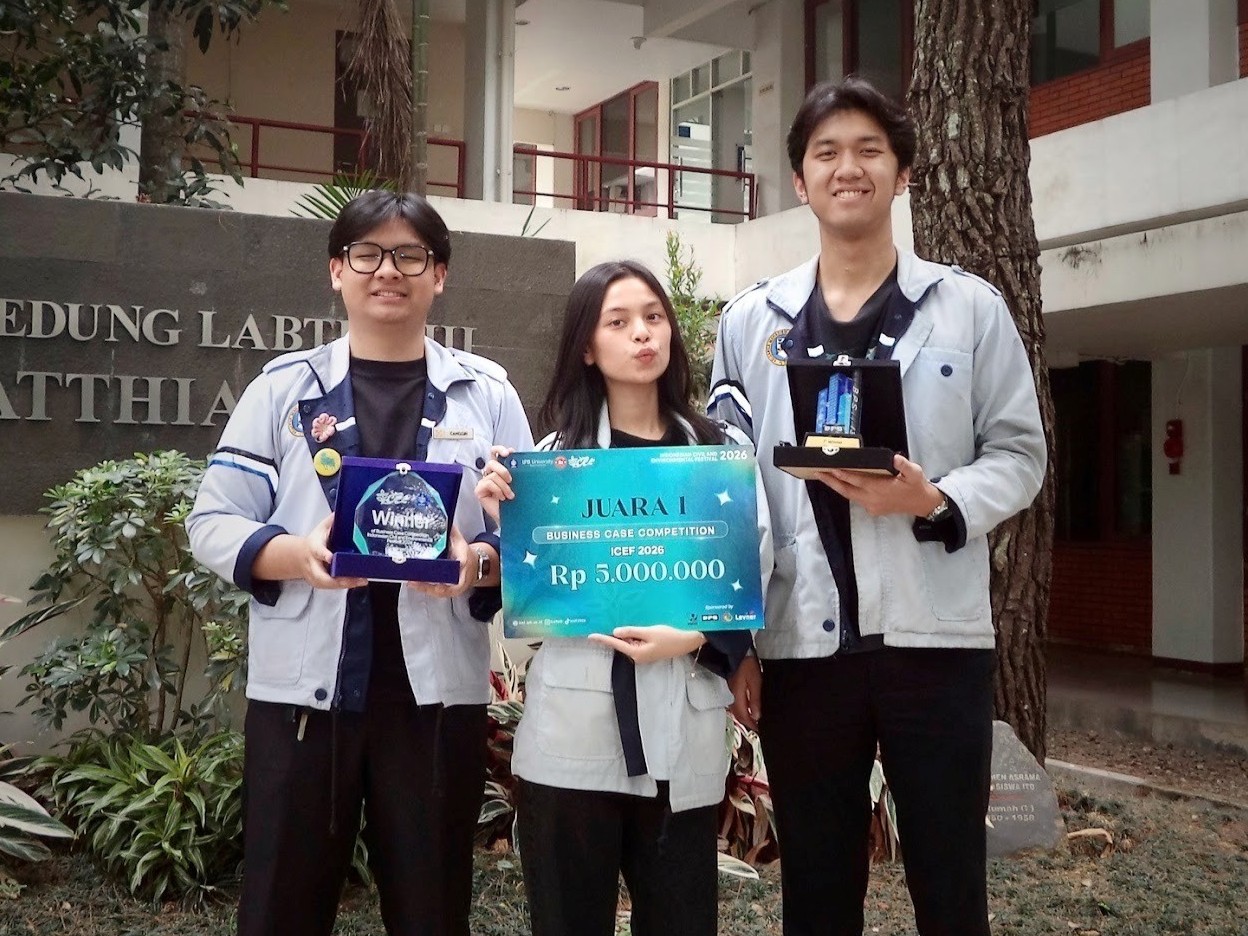
The idea was developed by Mesya Christantri and Rafi Raihan Herawan, students of the Agricultural Engineering Study Program, class of 2023, and Agnes Ruth Savira, a student of the Postharvest Technology Study Program, class of 2023. Through AgroSmart, the team secured second place at the Agricultural Food Competition (AFC) Season 17, organized by the Food Technology Student Association of Universitas Jenderal Soedirman.
Through AgroSmart, the team developed a crop recommendation system that uses machine learning to process data on temperature, rainfall, solar radiation, soil characteristics, and environmental conditions in real time.
Unlike conventional recommendation systems, AgroSmart is designed to update its recommendations whenever weather conditions change during the growing season. The system is also equipped with features such as Adaptive Threshold, Emergency Shift, and Risk-Benefit Analysis, enabling farmers to make faster and more accurate decisions when facing extreme weather.
During the development process, the team encountered challenges in conducting the gap analysis. Agnes explained that the difficulty arose because the proposed technology has not been widely implemented in Indonesia, resulting in very limited available references.
As the team adopted a relatively new approach, they held extensive discussions with their academic supervisor to ensure that the concept was supported by a strong scientific foundation.
Under the guidance of Dr. Indrawan Cahyo Adilaksono, S.TP., M.Agr.Sc., a lecturer in the Agricultural Engineering Study Program at ITB’s School of Life Sciences and Technology (SITH), the students explored the use of machine learning to support decision-making in agriculture while further refining the AgroSmart system.
Looking ahead, the team hopes that AgroSmart will not remain merely an idea presented in a competition, but will be developed into a technology that can provide tangible benefits to society.
“We hope that AgroSmart can be commercialized in the future so that it can be used by farmers from various backgrounds,” Mesya said.
Reporter: Kayla Annisa Erian (Environmental Infrastructure Engineering, 2023)
.jpeg)
.jpg)
.jpg)
.jpg)