Prof. Stella Christie Highlights AI Challenges: From Economic Bubbles to the Sustainability of Higher Education
By Jekky - Mahasiswa Teknik Pertambangan, 2023
Editor M. Naufal Hafizh, S.S.
.jpg)
BANDUNG, itb.ac.id – The rapid development of artificial intelligence (AI) is increasingly influencing various aspects of life. However, alongside the enormous opportunities offered by the technology, important questions are emerging about its economic and environmental impacts, as well as the future of higher education.
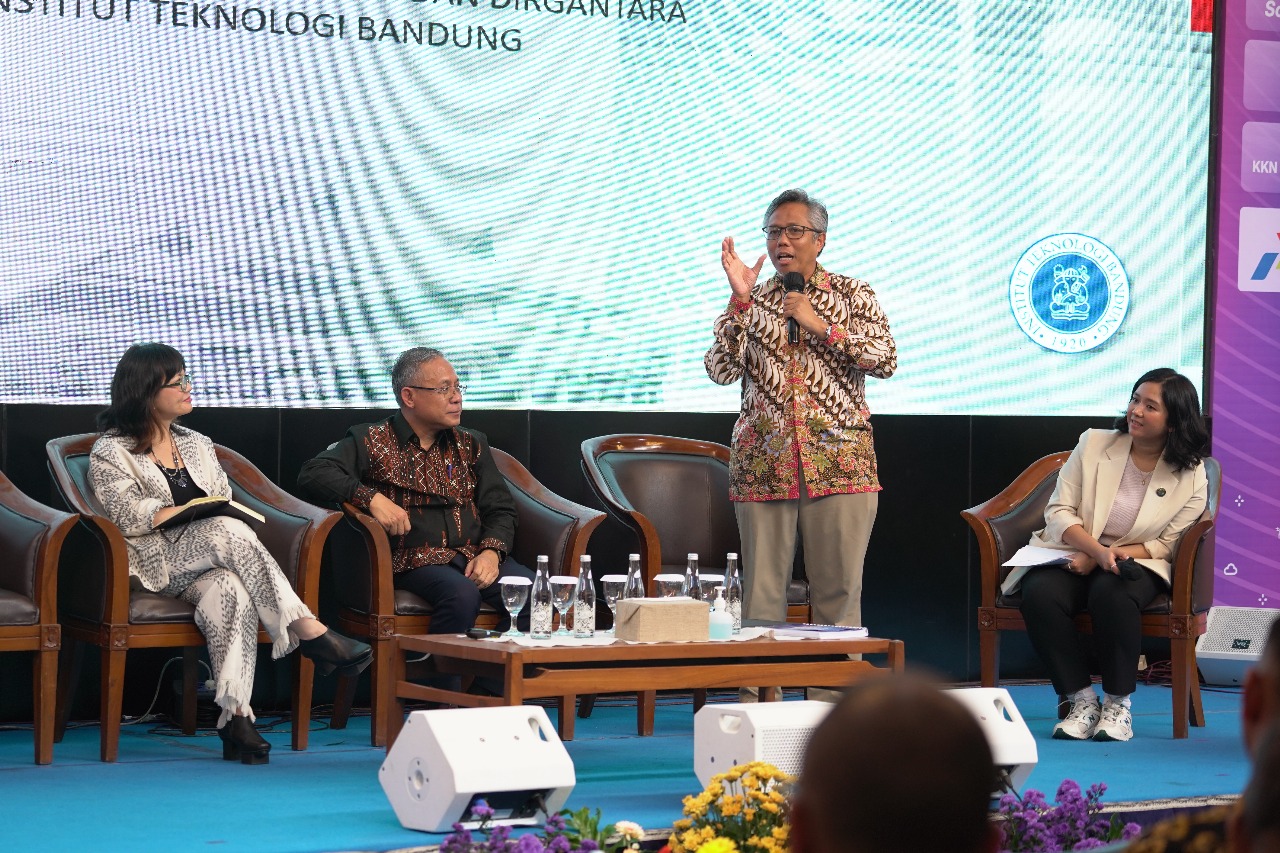
The issue was raised by Deputy Minister of Higher Education, Science, and Technology Prof. Stella Christie during her keynote speech at the AI Indonesia Initiative Forum (AIIF) 2026, themed “AI Action for the Transformation of a Smart Indonesia.” In her presentation, Prof. Stella encouraged participants to take a more critical look at the development of AI, including questioning whether the current growth of AI is creating an economic bubble and how much the world must pay to sustain such ambitions.
Is AI Creating an Economic Bubble?
Prof. Stella opened her presentation by inviting participants to look back at several economic phenomena in history, including the tulip mania in the Netherlands in the 17th century and the dot-com bubble. According to her, a bubble can emerge when almost every problem across different fields appears to have the same answer.
“How can we cure cancer? AI. How can we prove a mathematical theorem? AI. How can we increase company profits? AI. How can we improve the quality of education? AI,” she explained.
Prof. Stella emphasized that these answers are not necessarily wrong. However, the tendency to make AI the answer to almost every problem should be viewed critically as a potential warning sign.
The Environmental Cost of AI Development
.jpg)
Beyond economic concerns, Prof. Stella highlighted another aspect that she said has received relatively less attention in discussions about AI: the energy and water required to operate AI systems.
She explained that in 2025, AI’s energy consumption was estimated to be equivalent to the annual energy consumption of the entire population of Latvia. This demand is projected to continue increasing, reaching levels comparable to Italy’s energy consumption in 2028 and the United Kingdom’s in 2029.
“By 2030, there will be no European country whose energy consumption can match that of AI. In 2030, we will have to go to Canada,” she said.
Water consumption to support AI infrastructure is another concern. Prof. Stella noted that ChatGPT-4 had used an amount of clean water that, according to her calculation, was equivalent to the annual water needs of 1.2 million people. She said this was comparable to the water needs of around 50 large hospitals and 325 universities in the United States.
“If even simple things require this much drinking water to disappear from the Earth, how much will be needed if AI actually cures cancer?” she stressed.
Three Pillars of Higher Education in the AI Era
Amid these developments, Prof. Stella placed particular emphasis on the role of higher education institutions. She argued that universities need to develop a new modus operandi based on three key areas: the creation of knowledge, the transmission of knowledge, and the curation of knowledge.
Under the first pillar, creation of knowledge, Prof. Stella encouraged universities to redefine the role of humans in creating knowledge. This has become increasingly important as AI is now capable of generating various forms of new knowledge.
“We cannot simply stand in the middle and say that both have a role. We have to determine which role belongs to humans and which belongs to AI,” Prof. Stella said.
Meanwhile, under the second pillar, transmission of knowledge, she questioned the purpose of transmitting knowledge in an era when information is increasingly accessible. Today, various facts can be found with just one click. Therefore, universities need to reconsider what types of knowledge are important to transmit.
Such knowledge may be directed toward advancing technology, controlling the use of AI, developing human capabilities, or preserving knowledge that is increasingly being abandoned but still holds value.
Prof. Stella cited hand-drawn batik as an example. Hand-drawn batik continues to hold significant value not merely because of its final product, but also because of the process and human involvement behind its creation.
The third pillar, curation of knowledge, is one that Prof. Stella said is discussed less frequently, despite its importance. Knowledge curation concerns the human ability to determine which facts and phenomena are truly important and relevant for civilization to understand.
“Knowledge is not a list of all the facts that exist in the world. It is a curation of facts and phenomena that we consider interesting and useful to know,” she said.
She cited the equation E = mc², introduced by Albert Einstein, as an example. The equation is not merely a collection of facts, but rather the result of a process of identifying and curating patterns within physical phenomena.
In closing, Prof. Stella acknowledged that the various questions surrounding the development of AI do not yet have a single answer. Instead, she said, these questions should serve as the starting point for further discussion, particularly among higher education institutions.
“This is the beginning of a discussion. The most fundamental question for us is how universities can remain sustainable in the era of Artificial Intelligence,” she concluded.

.jpg)
.jpeg)
.jpg)