Towards Future Spatial Planning, SAPPK ITB Professor Emphasizes Resilience, Digitalization, and Inclusivity
By --- -
Editor Muhammad Efriza Pandia

Doc. Prof. Ir. Ridwan Sutriadi, S.T., M.T., Ph.D.
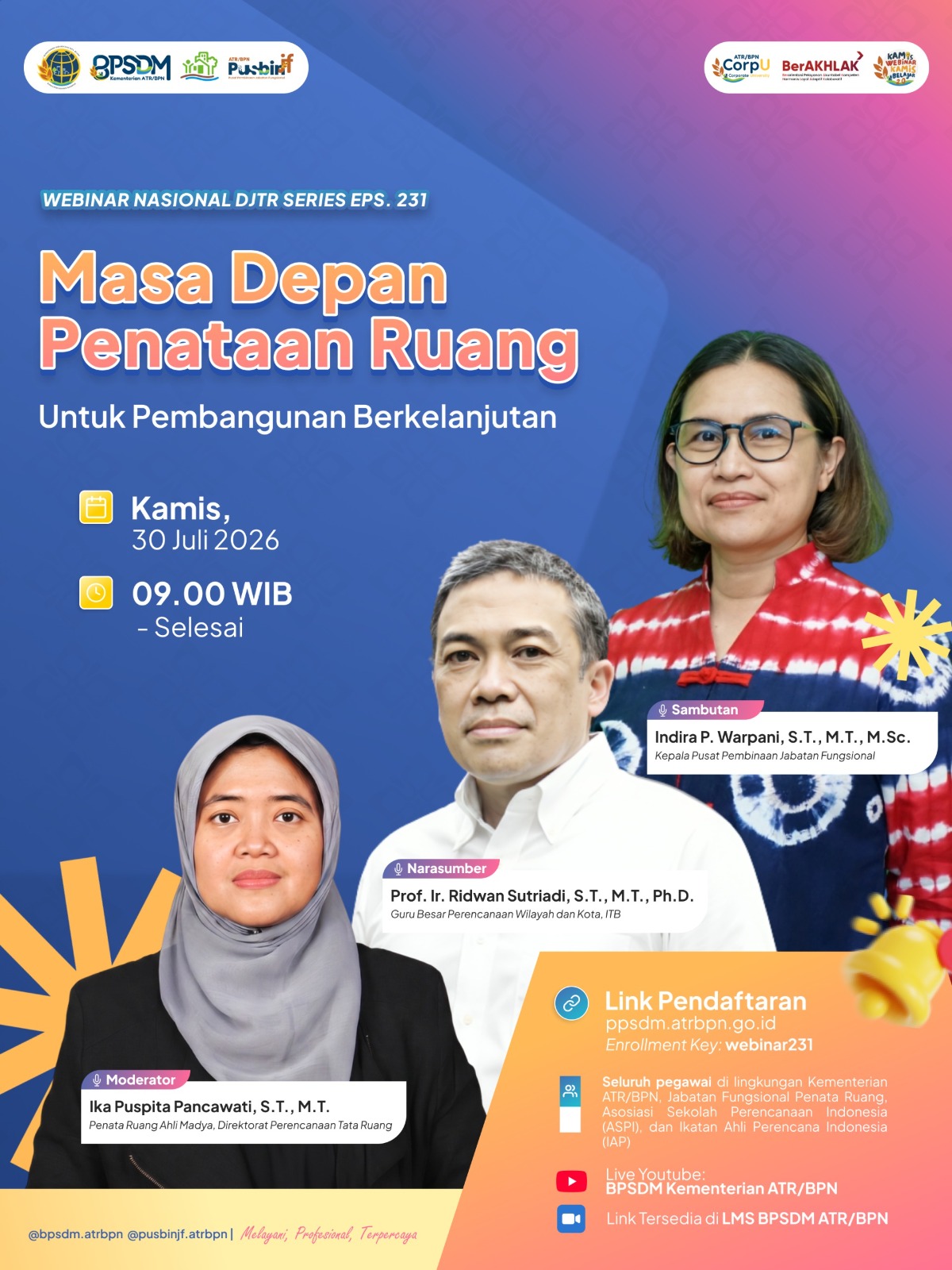
BANDUNG, itb.ac.id – Professor of the School of Architecture, Planning, and Policy Development (SAPPK) Institut Teknologi Bandung (ITB), Prof. Ir. Ridwan Sutriadi, S.T., M.T., Ph.D., was a speaker at a national webinar titled "The Future of Spatial Planning for Sustainable Development," organized by the Human Resources Development Agency (BPSDM) of the Ministry of Agrarian Affairs and Spatial Planning/National Land Agency (ATR/BPN) on Thursday (July 30, 2026).
In the event, Prof. Ridwan discussed the transformation of spatial planning toward a more adaptive, sustainable, data-driven approach that is responsive to environmental dynamics and community needs. He stated that the increasingly complex development of cities and regions means that spatial planning can no longer be understood simply as the preparation of static maps or master plans.
"The spatial planning paradigm has evolved from a blueprint or traditional approach to a systems approach, now entering the contemporary era that prioritizes system integration, sustainability, resilience, digital twins, real-time monitoring, and feedback mechanisms. Therefore, spatial planning needs to be part of a regional management cycle that is continuously updated in line with changing social, economic, environmental, and technological conditions," he said.
Sustainability as the Foundation of Spatial Planning
In his presentation, Prof. Ridwan linked sustainable spatial planning to the WEHAB framework, which encompasses water, energy, health, agriculture, and biodiversity.
In the water aspect, for example, watershed boundaries and groundwater conditions need to be primary considerations in spatial allocation. Approaches such as water-sensitive urban design, sponge cities, spring protection, riverbank green belts, and retention parks can be used to increase regional resilience to water issues. Meanwhile, from an energy perspective, compact city structures, mixed-use land use, and Transit-Oriented Development (TOD) can help reduce travel distances and energy consumption.
"Spatial planning also needs to support public health by providing easily accessible green open spaces, pedestrian and bicycle networks, and controlling the urban heat island impact. Furthermore, protecting productive land, developing urban agriculture, and connecting green spaces are crucial for maintaining food security and biodiversity," he said.
Five Important Directions for Future Spatial Planning
He outlined several key terms that need to be considered in sustainable spatial planning, namely resilience, spatio-digital transformation, smart growth and compactness, integrated governance, and inclusivity.
Resilience places environmental carrying capacity and disaster and climate risks as crucial considerations in development. Meanwhile, spatial digital transformation encourages the use of integrated geospatial data to produce evidence-based planning.
"Technological developments also open up opportunities for the use of Urban Digital Twins, GeoAI Analytics, One Spatial Data, and real-time monitoring. These technologies can transform previously static maps into dynamic spatial information systems, help detect changes in land use, conduct development simulations, and support more precise decision-making," he explained.
However, Prof. Ridwan emphasized that technology remains a tool. Spatial planning must ultimately place humans as a vital part of the planning process. Therefore, meaningful public participation, spatial equity, universal accessibility, and collaborative planning need to be part of future spatial governance.
Spatial Planning as a Living Document
In facing future uncertainty, Prof. Ridwan highlighted three important skills: Thinking Ahead, Thinking Again, and Thinking Across. Thinking Ahead is necessary to anticipate climate change, disaster risks, and technological developments. Thinking Again means having the courage to evaluate and improve policies or zoning that are no longer effective. Thinking Across emphasizes the importance of studying good practices from various regions and adapting them to Indonesia's local character and wisdom.
This approach then needs to be translated into adaptive policies, namely making spatial plans a living document, not a rigid plan. Their implementation must be accompanied by spatial utilization controls, incentives and disincentives, law enforcement, and Regular spatial audits.
Through this approach, spatial planning is expected to not only regulate development locations but also become a strategic instrument for realizing safe, comfortable, productive, resilient, inclusive, and sustainable regions. Future spatial planning also requires synergy between human expertise, technological utilization, adaptive governance, and a focus on environmental sustainability and community needs.