School of Pharmacy
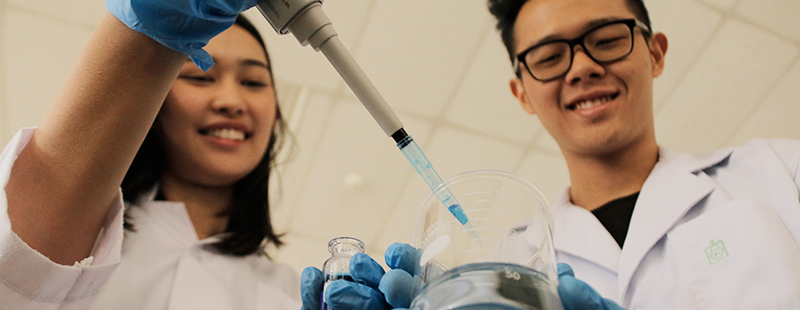
General Information and History
The School of Pharmacy at ITB was established on October 6, 1947, as the Department of Pharmacy under the Faculteit voor Wiskunde en Natuurwetenschappen. At that time, the faculty was part of the University of Indonesia. On February 1, 1949, the faculty was renamed the Faculty of Mathematics and Natural Sciences (FIPIA), while remaining under the University of Indonesia. The organizational structure of the Department of Pharmacy was initially very simple, with only one person responsible for managing the department. Beginning in 1959, however, the organization expanded and a secretary was appointed to assist the head of the department.
In 1953, for the first time, an Indonesian citizen, Prof. dr. Rd. Mhd. Djuhana Wiradikarta, was appointed Dean of FIPIA. He was also a member of the academic staff of the Department of Pharmacy and served as dean until 1959. On March 2, 1959, the Faculty of Engineering and FIPIA were merged to form a new institution, Institut Teknologi Bandung (ITB). The Department of Pharmacy subsequently became part of the Department of Chemistry and Biology until 1961. Following an organizational restructuring in 1973, the Department of Pharmacy became part of the Faculty of Mathematics and Natural Sciences.
Until 1987, the Department of Pharmacy consisted of five academic divisions: Pharmaceutical Chemistry, Formulation, Pharmaceutical Biology, Pharmacology, and Basic and Supporting Sciences. Each division represented a related area of science or a group of academic and applied disciplines within pharmacy. Their activities covered theoretical instruction, laboratory practice, and research. Each division offered several courses and was led by an academic staff member who was responsible for managing and developing the division, including its lectures, laboratory activities, and research projects. Each laboratory was managed and supervised by a laboratory head, while every member of the department's academic staff had specific responsibilities for teaching, supervising practical laboratory work, and advising student research projects.
This academic organization gradually developed and expanded. The School currently has five Research Groups: Pharmaceutics, Pharmacochemistry, Pharmacology, Clinical Pharmacy, and Pharmaceutical Biology and Sports.
In the early years following its establishment in 1947, students admitted to the Department of Pharmacy were graduates of Category B secondary schools, such as HBS, AMS, VHO, or equivalent secondary schools. Courses were delivered in Dutch and English. The program lasted 5.5 years, consisting of a three-year baccalaureate stage and a 2.5-year undergraduate stage. Graduates had the opportunity to continue to doctoral-level education provided that they had completed at least one major subject, or hoofdvak, and two minor subjects, or bijvak. Chemistry, for example, could serve as a major subject, while botany, zoology, and physics could be taken as minor subjects. At that time, the curriculum was not yet well structured and there was no specified maximum period of study. Beginning in 1951, several subjects were added to the curriculum in response to developments and needs within the education system.
Due to the insufficient number of pharmacists in Indonesia, the Government, through the Indonesian Ministry of National Education, introduced regulations establishing a four-year university pharmacy program. The program consisted of one year of preparatory education, one year of pre-pharmacy education, and two years of pharmacy education.
In 1960, the duration of pharmacy education was extended to six years, consisting of five years of undergraduate education and one year of professional education. The curriculum was revised and adjusted to meet the needs of the education system. Several new courses were introduced, including English, Military Education, Prescription Science, and others.
In 1973, significant changes were introduced at ITB. All newly admitted students were required to complete the Common Preparatory Level, known as Tahap Persiapan Bersama (TPB), before entering any department. The Semester Credit System (SKS) was also implemented. Students were allowed to select their courses up to a maximum of 24 credits per semester. This system gave students greater flexibility to develop their individual academic abilities throughout their studies. The curriculum was subsequently revised every five years to reflect developments in science and technology in Indonesia. The curriculum in effect at the time of this account was the 2008 Curriculum.
In addition to its undergraduate programs, the School of Pharmacy also offers master's and doctoral programs. Eight areas of specialization are available within the master's and doctoral programs: Pharmaceutical Analysis, Medicinal Chemistry, Pharmaceutical Technology, Biopharmacy, Pharmacognosy and Phytochemistry, Pharmacology and Toxicology, Food Analysis and Safety, and Hospital Pharmacy. The School of Pharmacy also offers a one-year Pharmacist Professional Program. The program includes coursework, professional pharmacy practice, and a comprehensive examination.
In 1996, the Department of Pharmacy at ITB moved into a new facility, Laboratory Technology Building VII, or Labtek VII, located in the central area of the ITB campus next to the Electrical Engineering Building and the Faculty of Mathematics and Natural Sciences. Occupying a site of 6,579 square meters, the Department of Pharmacy optimized its facilities and infrastructure to better serve students and stakeholders. A wide range of modern instruments and facilities were provided and supported by experienced staff. These developments helped establish the Department of Pharmacy at ITB as one of the leading institutions for pharmacy education in Indonesia.
Based on ITB Rector Decree No. 222/SK/1001/OT/2005, signed on August 29, 2005, the status of the Department of Pharmacy was changed to the School of Pharmacy, effective from August 29, 2005. Beginning in 2006, the School of Pharmacy offered two undergraduate degree programs: the Pharmaceutical Science and Technology Program and the Clinical and Community Pharmacy Program.
Faculties and Schools
- Faculty of Earth Sciences and Technology
- Faculty of Mathematics and Natural Sciences
- Faculty of Art and Design
- Faculty of Industrial Technology
- Faculty of Mechanical and Aerospace Engineering
- Faculty of Mining and Petroleum Engineering
- Faculty of Civil and Environmental Engineering
- School of Architecture, Planning, and Policy Development
- School of Business and Management
- School of Pharmacy
- School of Life Sciences and Technology
- School of Electrical Engineering and Informatics